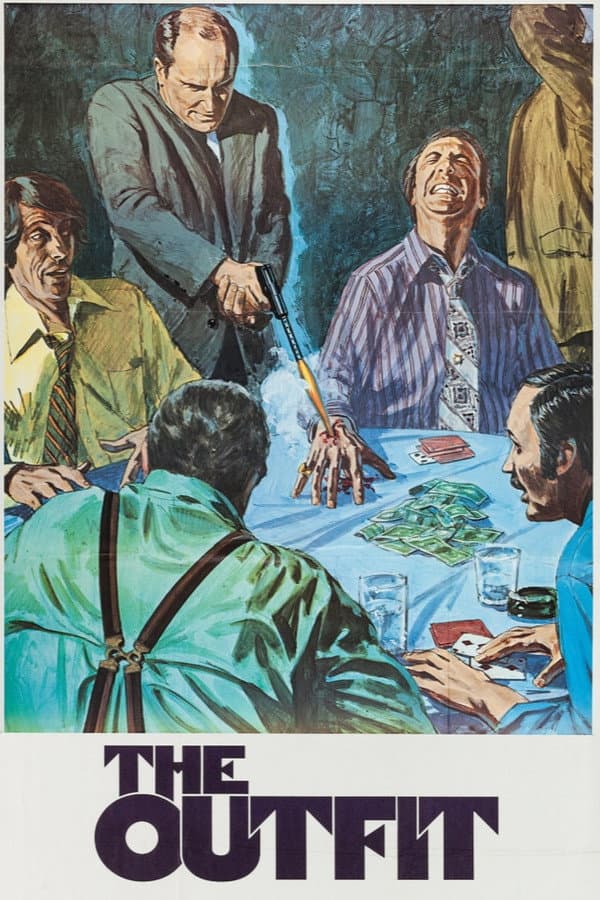
The Outfit

The Outfit

1973 • Crime, DramaPG
A two-bit criminal takes on the Mafia to avenge his brother's death. Earl Macklin is a small time criminal who is released from prison after an unsuccessful bank robbery only to discover that a pair of gunmen killed his brother.
Runtime: 1h 43m
Buy related books from Amazon

As an Amazon Associate I earn from qualifying purchases. Read the full disclosure.

Why you should read the novel

Before you press play, consider opening The Outfit by Richard Stark (Donald E. Westlake). The original Parker novel delivers razor-edged prose, relentless momentum, and the cold-blooded precision that defined hardboiled crime fiction. Stark’s minimalist style pulls you into a world where every glance, getaway, and double-cross matters—and where consequences hit harder than any on-screen shootout. Reading the source novel gives you what the movie can’t: Parker’s unflinching interiority, the meticulous mechanics of each job, and the elegant architecture of a crime syndicate under siege. You’ll feel the calculations behind every move and the ripple effects across a nationwide underworld. If you love gritty neo-noir, the Parker series is essential. Start with The Outfit to experience the blueprint the film adapts, then keep going to discover a rich continuum of lean, interlocking capers that reward close reading and deliver authentic hardboiled thrills.

Adaptation differences

Names and identities change significantly. In Richard Stark’s novel, the lead is Parker—an implacable professional thief with a long-running series arc. The film renames him Earl Macklin, reshaping the character’s history and motivations. Likewise, Parker’s trusted ally Handy McKay becomes Cody on-screen, altering dynamics and tone from seasoned, world-weary partners to a looser, buddy-crime pairing. Scope and structure shift from the book’s wide lens to the movie’s tighter focus. The novel orchestrates a coordinated campaign: Parker mobilizes independent crews nationwide to hammer the Outfit on multiple fronts. The adaptation condenses this into a handful of personal strikes by Macklin and Cody, streamlining the plot into a more conventional revenge-and-extortion throughline. Tone and POV diverge sharply. Stark’s prose is clinical, unsentimental, and interior—third-person limited that keeps you in Parker’s head as he makes ice-cold calculations. The movie externalizes motives through dialogue and action, adds moments of humor and warmth, and foregrounds relationships (including a more pronounced romantic subplot) that are far less central in the novel’s austere world. The climax and period feel also differ. The book’s pressure campaign leads to negotiation and a hard-nosed settlement consistent with Parker’s professional code. The film favors a cathartic, bullet-riddled showdown. Additionally, the novel’s early-1960s setting informs its underworld logistics and etiquette, while the adaptation updates the vibe to early-1970s Americana—cars, clothes, and attitudes—shifting the story’s texture even when broad plot beats align.

The Outfit inspired from

The Outfit
by Richard Stark (Donald E. Westlake)

Movies by the same author(s) for
The Outfit