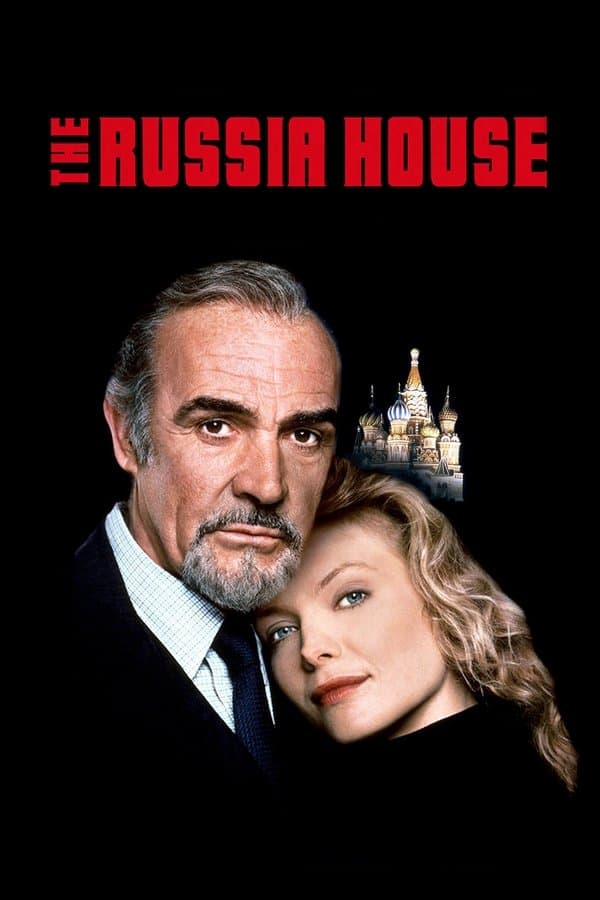
The Russia House
1990 • Drama, Romance, Thriller • R
Barley Scott Blair, a Lisbon-based editor of Russian literature who unexpectedly begins working for British intelligence, is commissioned to investigate the purposes of Dante, a dissident scientist trapped in the decaying Soviet Union that is crumbling under the new open-minded policies.
Runtime: 1h 58m
Buy related books from Amazon
As an Amazon Associate I earn from qualifying purchases. Read the full disclosure.
Why you should read the novel
Before you press play on The Russia House (1990), open John le Carré’s novel The Russia House and experience Cold War spy fiction at its source. Le Carré’s masterful prose, lived-in tradecraft, and moral nuance draw you into a world the screen can only summarize.
On the page, Barley Blair’s voice, Katya Orlova’s courage, and “Dante’s” dangerous secret deepen into complex portraits of loyalty and love under surveillance. The novel’s layered interrogations, memos, and competing recollections reveal the political stakes and human costs behind every clandestine choice.
If you crave intelligent espionage, richly textured settings, and the kind of psychological depth that made John le Carré a legend, read The Russia House. This Cold War thriller delivers a more immersive, thought-provoking journey than any two-hour movie ever could.
Adaptation differences
The Russia House book vs movie differences begin with structure and tone. Tom Stoppard’s screenplay streamlines le Carré’s dossier-like storytelling—briefings, debriefings, memos, and multiple perspectives—into a more linear, romance-forward narrative. The film highlights Barley and Katya’s love story and visual atmosphere, while the novel lingers on bureaucratic infighting, ethical gray zones, and the procedural grind of intelligence work.
Characterization is significantly deeper in the novel. On screen, Sean Connery and Michelle Pfeiffer embody Barley Blair and Katya Orlova with economy; on the page, le Carré unpacks Barley’s self-doubt, linguistic finesse, and divided loyalties, as well as Katya’s obligations, fears, and quiet resolve. The book also devotes far more time to the British and American services—their rivalries, petty egos, and institutional logic—often merging or minimizing such roles in the film to keep the plot moving.
Plot mechanics and ambiguity are more intricate in the novel than in the adaptation. Le Carré details tradecraft, the crafting of questionnaires, and the painstaking evaluation of “Dante’s” material, inviting readers to question sources, motives, and manipulation at every step. By contrast, the movie clarifies and compresses these operations, and its ending offers a cleaner, more emotionally resolved payoff, whereas the book preserves greater uncertainty about what is truly gained, lost, or merely exchanged.
Language, setting, and theme diverge as well. The book revels in the texture of everyday Soviet life, the perils of translation, and the weaponization of words, all of which feed its skeptical view of power. The film, shot on remarkable Soviet locations and buoyed by a jazz-inflected score, externalizes mood beautifully but inevitably trims the novel’s linguistic wit and socio-political detail. For readers seeking the fullest measure of John le Carré’s themes, the novel remains the definitive Russia House experience.
The Russia House inspired from
The Russia House
by John le Carré