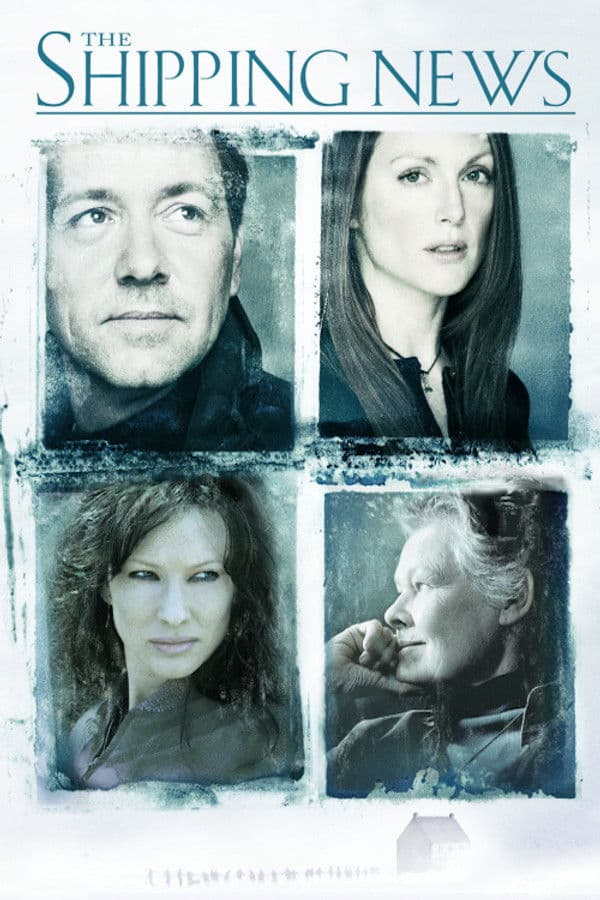
The Shipping News
2001 • Drama, Romance • R
An emotionally-beaten man with his young daughter moves to his ancestral home in Newfoundland to reclaim his life.
Runtime: 1h 51m
Buy related books from Amazon
As an Amazon Associate I earn from qualifying purchases. Read the full disclosure.
Why you should read the novel
If the film The Shipping News drew you in, the novel by Annie Proulx will immerse you completely. Winner of both the Pulitzer Prize and the National Book Award, The Shipping News book offers deeper character insight, richer atmosphere, and a more textured exploration of grief, renewal, and belonging than any two-hour adaptation can deliver.
Reading the novel unlocks Proulx’s masterful language—salt-sprayed sentences, darkly comic turns, and vivid descriptions of Newfoundland’s weather, work, and folklore. Chapter epigraphs about maritime knots, layered local history, and the rhythms of the Gammy Bird newsroom create a living sense of place the movie can only suggest.
For readers who love literary fiction, coastal settings, and redemptive journeys, the Annie Proulx novel is the definitive experience. Read the book before or after the movie to understand the full emotional arc, the cultural nuance, and the unforgettable craft behind this acclaimed source material.
Adaptation differences
Tone and intensity shift notably from page to screen. The novel leans into dark humor, grotesque edges, and multi-generational trauma with a frankness the film softens. Harsh family histories and the rawness of Quoyle’s past are made less explicit onscreen, resulting in a warmer, more broadly comforting mood.
Characterization is streamlined. On the page, Quoyle is younger, massively overweight, and more physically ungainly; the film’s casting presents him as older and far less imposing, which changes how others respond to him. Aunt Agnis Hamm’s sexuality is clearly developed in the book but largely implicit in the movie. The romance with Wavey Prowse unfolds more slowly and cautiously in the novel, while the film accelerates their connection and trims or combines several supporting figures from the Gammy Bird and the wider community.
Structure and voice are transformed. Proulx’s chapters open with knot lore and teem with nautical terms and Newfoundland dialect; the film opts for a conventional narrative arc and minimizes dialect for accessibility. Episodic newsroom assignments and richly tangential local stories that build the setting’s depth in the book become brief beats or disappear entirely in the adaptation.
Themes and resolution differ in emphasis. The novel favors gradual, hard-won healing with lingering ambiguities, while the film gravitates toward a tidier, hopeful closure. Iconic moments—such as the peril and logistics around the family house—are visually striking in the movie but compressed, reducing the patient accumulation of meaning that the book achieves through time, detail, and interiority.
The Shipping News inspired from
The Shipping News
by Annie Proulx