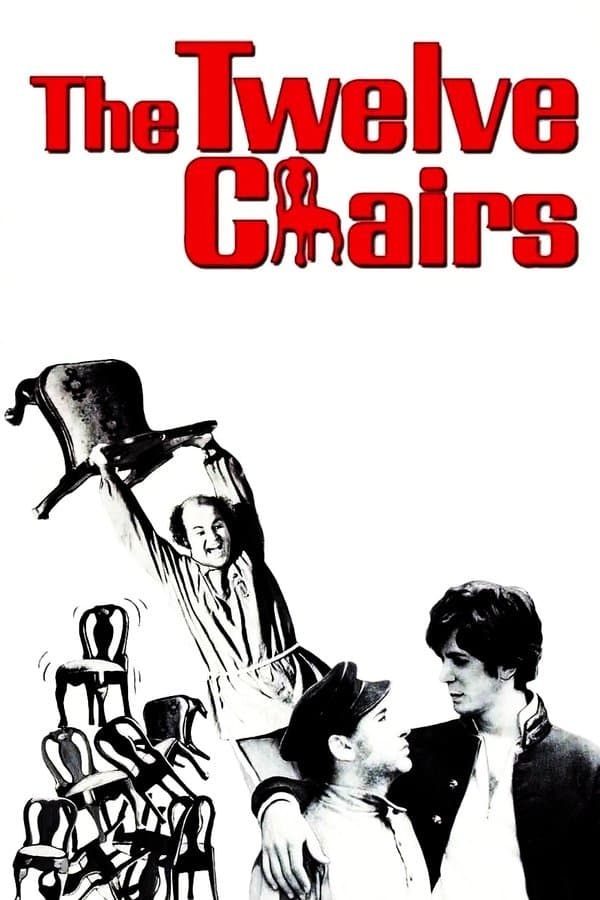
The Twelve Chairs
1970 • Comedy, Drama • G
In 1920s Soviet Russia, a fallen aristocrat, a priest and a con artist search for a treasure of jewels hidden inside one of twelve dining chairs, lost during the revolution.
Runtime: 1h 34m
Buy related books from Amazon
As an Amazon Associate I earn from qualifying purchases. Read the full disclosure.
Why you should read the novel
Skip the screen and open the source: The Twelve Chairs by Ilya Ilf and Evgeny Petrov is a razor-sharp comic novel whose social satire and linguistic fireworks no film can fully capture. On the page, Ostap Bender’s schemes sparkle with layers of wordplay, cultural allusion, and perfectly timed irony that reward close reading and re-reading.
The book’s picaresque sweep is vastly richer than any adaptation, crisscrossing 1920s Soviet life with a parade of unforgettable side characters, provincial detours, and set pieces that lampoon bureaucracy, greed, and ambition. Its famous aphorisms and verbal riffs—difficult to translate fully—give the novel an energy and bite movies inevitably smooth over.
If you want the full measure of Ilf and Petrov’s classic satire, read the novel. Modern English editions preserve the humor and context, offering annotations that illuminate the NEP era, Ostap Bender’s legend, and the poignant moral undercurrents beneath the laughs.
Adaptation differences
Ending and tone diverge sharply. In the novel, Vorobyaninov murders Ostap Bender in a grim, ironic climax—only to learn the jewels were already found and spent on a public institution. Mel Brooks’ 1970 film spares Bender and opts for a gentler, bittersweet finale, trading the book’s stiletto irony for humane comedy.
Political and social satire is toned down on screen. Ilf and Petrov’s book skewers NEP-era hustlers, bureaucrats, and clergy with pointed specificity; the film trims Soviet-targeted jokes and leans on universal, broadly accessible humor. Father Fyodor becomes a mostly slapstick foil, with fewer of the novel’s darker, more acerbic beats.
Structure and scope are compressed. The novel’s episodic road narrative spans numerous cities, detours, and minor characters; the film condenses journeys, merges roles, and relocates or simplifies set pieces for momentum. As a result, the book’s kaleidoscopic social panorama narrows into a faster, cleaner caper.
Characterization shifts toward warmth. On the page, Bender’s amoral brilliance and verbal pyrotechnics are sharper, while Vorobyaninov is more pitiable and venal; the movie softens edges, adds musical touches, and nudges their partnership toward buddy-comedy chemistry. Many of the novel’s famous quips and aphorisms—central to its voice—are inevitably replaced by new English-language gags.
The Twelve Chairs inspired from
The Twelve Chairs
by Ilya Ilf, Evgeny Petrov