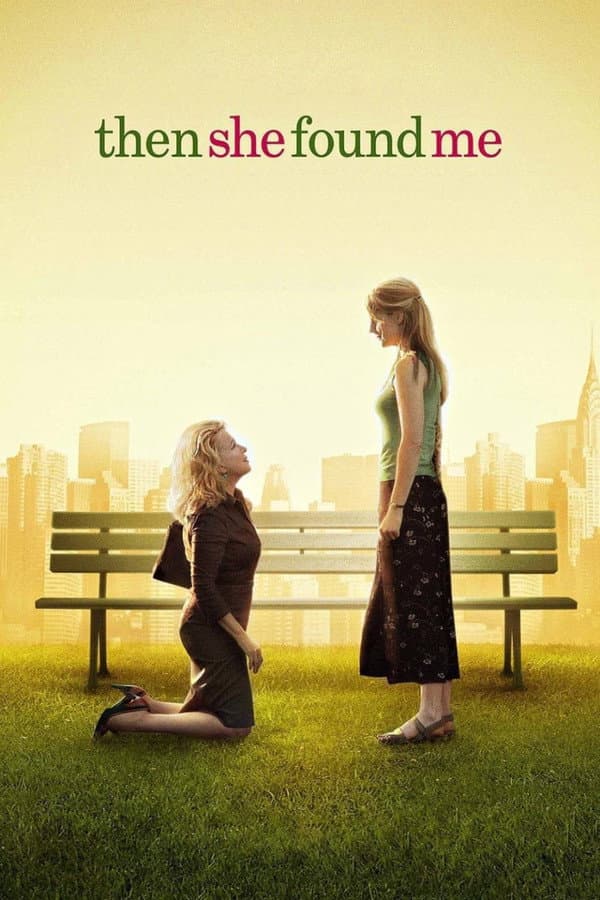
Then She Found Me
2007 • Comedy, Drama, Romance • R
A New York schoolteacher experiences a midlife crisis when, in quick succession, her husband leaves, her adoptive mother dies, and her biological mother, an eccentric talk show host, materializes and turns her life upside down as she begins a courtship with the father of one of her students.
Runtime: 1h 40m
Buy related books from Amazon
As an Amazon Associate I earn from qualifying purchases. Read the full disclosure.
Why you should read the novel
Before pressing play, consider reading Then She Found Me by Elinor Lipman—the insightful, witty novel that inspired the film. Lipman’s original prose delivers a richer tapestry of relationships, adoption, and midlife reinvention, with humor and heart that unfold on the page in unforgettable ways.
The novel’s nuanced characters and sparkling dialogue invite you into April Epner’s world with depth the screen can’t fully capture. If you love smart, character-driven fiction, Lipman’s humane wit and delicate emotional precision make the book a rewarding, re-readable experience.
For readers comparing book vs movie, the source novel offers layers of subtext, shades of motivation, and charming side characters that make every chapter feel alive. Discover why so many fans recommend: read the book first for the complete Then She Found Me story.
Adaptation differences
Then She Found Me book vs movie differences begin with tone. Elinor Lipman’s novel leans into a comic-of-manners sensibility—wry, affectionate, and quietly observational—while the film heightens the emotional stakes, emphasizing grief and the urgent desire for motherhood. The movie’s dramedy approach feels rawer and more immediate, where the book’s humor is subtler and more situational.
Character dynamics and focus shift as well. The film compresses and streamlines relationships, sharpening conflicts and creating clearer dramatic beats. April’s birth mother is renamed (Bernice Graves on screen versus the novel’s Bernice Graverman) and portrayed with a more overt celebrity sheen, intensifying the clash of personalities and public-versus-private identity in ways the novel handles with gentler, sly irony.
Plot emphasis changes notably. The movie foregrounds fertility struggles and miscarriage as major drivers of April’s choices—elements treated with far less centrality in the book. By accelerating timelines and amalgamating story threads, the adaptation creates a tighter arc around a few pivotal crises, whereas the novel allows relationships, obligations, and self-discovery to develop gradually across community, work, and family life.
Setting and period also diverge. The film situates the story in a distinctly New York, mid-2000s milieu—fast, compressed, and media-saturated—while the novel’s world reads more New England–rooted, with a softer, neighborhood feel and a 1990s sensibility. That shift, alongside a more overtly cathartic movie ending, makes the adaptation feel punchier and tidier, whereas the book leaves a touch more ambiguity and afterglow.
Then She Found Me inspired from
Then She Found Me
by Elinor Lipman