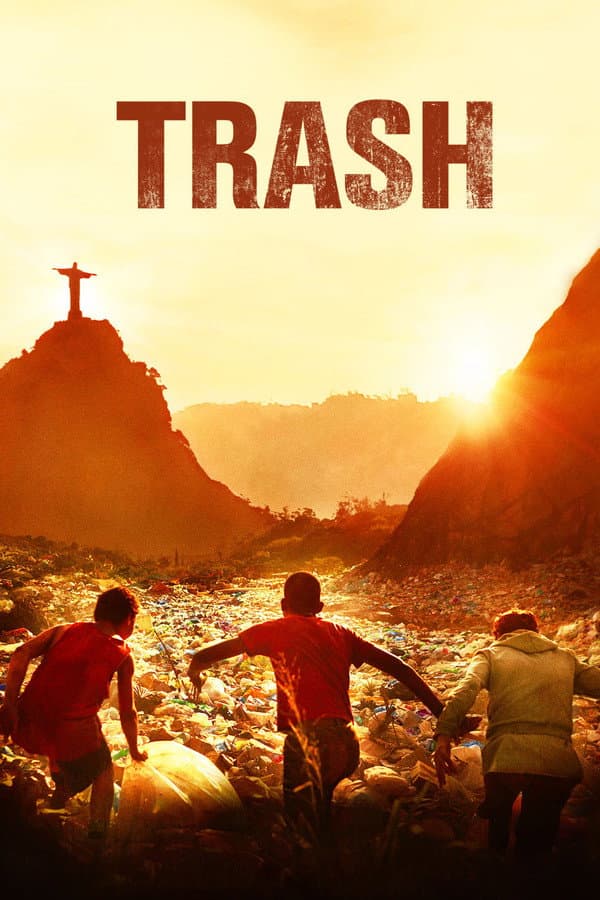
Trash
2014 • Adventure, Crime, Drama, Mystery, Thriller • R
Set in Brazil, three kids who make a discovery in a garbage dump soon find themselves running from the cops and trying to right a terrible wrong.
Runtime: 1h 54m
Buy related books from Amazon
As an Amazon Associate I earn from qualifying purchases. Read the full disclosure.
Why you should read the novel
Before you press play on Trash (2014), read the original Trash novel by Andy Mulligan. The book’s multi-voice storytelling immerses you in Raphael, Gardo, and Rat far beyond the film. If you crave suspense with heart and social insight, the source material delivers more meaning per page.
As a young adult novel, Trash blends breakneck pace with empathy and moral complexity. Andy Mulligan’s testimony-style chapters, layered clues, and vivid sense of place reward careful reading and reflection. For classrooms, book clubs, and curious readers, the novel sparks richer conversations than a two-hour viewing.
Searchers asking “Trash book vs movie” often want the deeper version—choose the book instead of watching the movie first. You’ll gain fuller character arcs, sharper themes, and clearer stakes. Start with the novel, then compare adaptations on your own terms.
Adaptation differences
If you’re comparing Trash 2014 vs novel, begin with setting. The book keeps its country unnamed around the Behala dumpsite, creating a universal, allegorical space. The film relocates events explicitly to Rio de Janeiro’s favelas, adds Portuguese, and leans into local color—one of the clearest differences between Trash movie and book.
Narrative perspective changes shape the experience. The novel uses rotating first-person testimonies—Raphael, Gardo, Rat, Father Juilliard, Sister Olivia, and others—inviting readers to judge competing voices. The movie streamlines this into a more conventional, outward-facing thriller, trading internal monologue and ambiguity for momentum, chase scenes, and visual exposition.
Plot and pacing shift, too. On the page, clues unfold methodically—keys, codes, letters, interviews—emphasizing puzzle-solving and ethical choices. On screen, timelines compress, clue paths simplify, and danger escalates; the adaptation privileges break-ins, pursuits, and confrontations with corrupt police to maintain kinetic energy.
Character emphasis and tone diverge in the finale. The book develops Rat’s backstory, day-to-day labor at the dump, and the quiet resolve of Father Juilliard and Sister Olivia with greater nuance. The film amplifies spectacle and violence, uses the adults as clearer moral anchors, and closes with a more cathartic, crowd-pleasing resolution than the novel’s reflective ending.
Trash inspired from
Trash
by Andy Mulligan