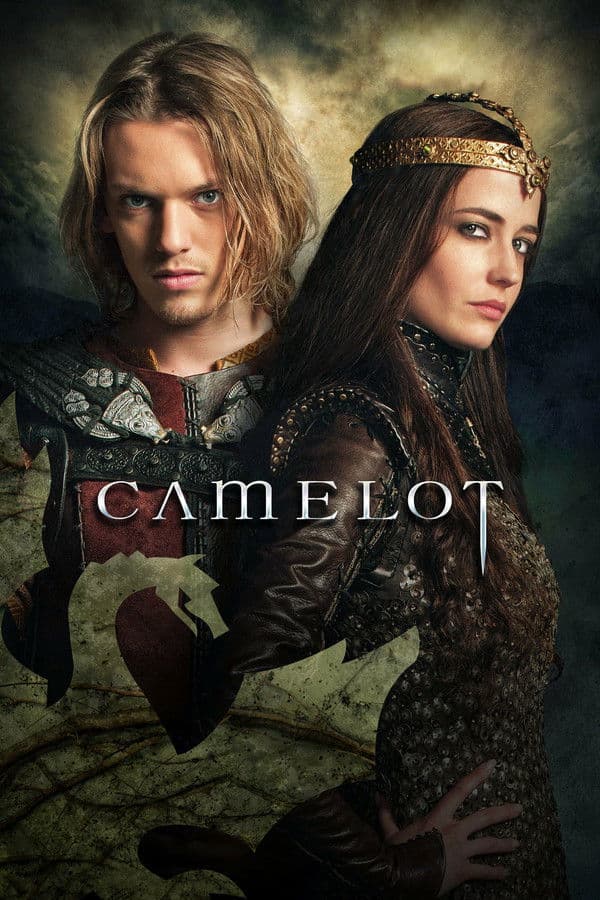
Camelot
2011 • Drama, Sci-Fi & Fantasy • TV-MA
With King Uther's sudden death, chaos threatens to engulf Britain. The sorcerer Merlin has visions of a dark future and installs young and impetuous Arthur, Uther's unknown son and heir raised as a commoner, as the new king. The two install themselves in Castle Camelot with their allies, which include Arthur's biological mother, his foster brother, and a quartet of loyal warriors. From Camelot, Arthur tries to build a new and better Britain, where people can live in peace.
Meanwhile, Arthur's cold half-sister Morgan plots to take the crown from him. Banished by Uther, who was responsible for her mother's murder to put Arthur's mother on the throne, Morgan is responsible for Uther's death and wants to rule as his successor. Aided by her loyal maid Vivian and the devious nun Sybil, Morgan takes up residence in Castle Pendragon, from where she schemes against Arthur.
Buy related books from Amazon
As an Amazon Associate I earn from qualifying purchases. Read the full disclosure.
Why you should read the novels
Before you stream Camelot (2011), experience the Arthurian legend where it lives most powerfully: in the books. From Sir Thomas Malory’s Le Morte d’Arthur to T. H. White’s The Once and Future King, the source texts deliver deeper worldbuilding, richer character arcs, and the mythic sweep that inspired every modern adaptation.
Looking for the best Arthurian legend books to read instead of watching the series? Start with Malory’s chivalric epic for the foundational tales, then savor White’s witty, moving retelling that shaped modern views of Arthur, Merlin, and Guinevere. Add Tennyson’s lyrical Idylls of the King and Bradley’s transformative The Mists of Avalon for perspectives the screen can’t match.
These classic Camelot books are easy to buy, download, or enjoy as audiobooks. Much is available in affordable editions—and Malory and Tennyson are public-domain, making them accessible for free. Read the originals that make Camelot (2011) feel bigger, braver, and more human on the page.
Adaptation differences
Camelot (2011) vs book: tone and setting. The series opts for gritty, post-Roman political realism, emphasizing council rooms, forts, and fragile alliances. Classic sources like Malory lean into chivalric romance and knightly quests, while Tennyson elevates courtly ideals and tragedy; White balances whimsy with moral complexity. The show narrows scope to intrigue, where the books sweep across decades of legend.
Camelot (2011) vs the books: characterization shifts. Merlin is recast as a calculating strategist who avoids overt magic because it carries a cost, contrasting with Malory’s prophetic enchanter and White’s eccentric, time-bent tutor. Morgan becomes the primary, ever-present antagonist, whereas the books vary: Malory’s Morgan is ambivalent and episodic; Bradley’s The Mists of Avalon centers her as a nuanced protagonist. Guinevere’s romantic conflict is reshaped into a triangle with Arthur and the knight Leontes, replacing the classic Lancelot-Guinevere affair.
Camelot (2011) vs source myths: magic and mythic artifacts. The series reframes Excalibur with darker, sacrificial or politically engineered origins and blends Sword-in-the-Stone motifs with pragmatic maneuvering; the books often distinguish the sword in the stone from Excalibur bestowed by the Lady of the Lake. Miracles, marvels, and enchantments that abound in Malory and Tennyson are scaled back or grounded on TV to sustain a realist tone.
Camelot (2011) vs classic Arthurian books: structure and themes. The TV narrative foregrounds early reign consolidation, scarce quests, and a slow-burn formation of Camelot’s institutions, while the books expand into the Round Table’s many adventures, moral tests, and the Holy Grail quest. Religious tensions are quieter in the show than in Bradley’s pagan-Christian focus, and the court’s chivalric code—central in Malory and Tennyson—is recast as flexible realpolitik.
Camelot inspired from
King Arthur and His Knights of the Round Table
by Roger Lancelyn Green
Idylls of the King
by Alfred, Lord Tennyson
The Once and Future King
by T. H. White
The Mists of Avalon
by Marion Zimmer Bradley
Le Morte d’Arthur
by Sir Thomas Malory