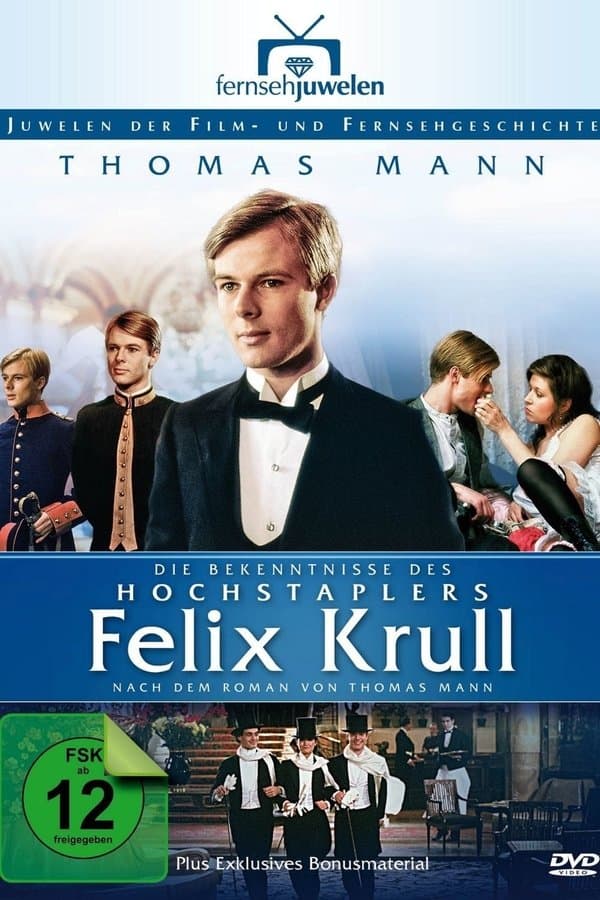
Confessions of Felix Krull
1982 • Drama • TV-MA
Based on unfinished 1954 novel by the German author Thomas Mann. It is a parody of Goethe's autobiography Poetry and Truth, particularly in its pompous tone.
Buy related books from Amazon
As an Amazon Associate I earn from qualifying purchases. Read the full disclosure.
Why you should read the novel
Before pressing play on the 1982 TV series Confessions of Felix Krull, discover the brilliance of Thomas Mann’s novel. The book delivers a richer, more ironic voice and picaresque wit that screen versions can only suggest. Reading the source unlocks Mann’s layered satire, his meticulous prose, and a firsthand tour through Felix’s audacious ascent.
The Confessions of Felix Krull, Confidence Man is classic literature at its most entertaining: a charming trickster, glittering European settings, and sharp social observation. Mann’s storytelling rewards readers with insight into class ambition, identity, and performance—nuances that thrive on the page. If you love character-driven capers, the novel’s refined humor and sly psychology are irresistible.
Experience Felix’s schemes as Mann intended—through the seductive intimacy of a confessional voice. The English translation preserves the novel’s elegance and musicality, making it an ideal entry point to Thomas Mann. For book lovers seeking depth, style, and unforgettable scenes, the original novel outshines any adaptation.
Adaptation differences
The TV adaptation condenses and rearranges episodes to create a smooth, linear caper, while the book unfolds as an expansive picaresque with digressions and sly asides. Mann’s narrative voice—Felix’s stylish, ironic confession—is central in the novel but necessarily reduced on screen, shifting emphasis from witty self-fashioning to visible action.
Thomas Mann’s philosophical and satirical undercurrents are fuller in the book. The novel lingers on social pretenses, moral ambiguity, and artistic performance, using language to tease out class satire and identity play. The series prioritizes pace and plot clarity, streamlining reflective passages and compressing secondary arcs for momentum.
Because the novel is famously unfinished, the adaptation supplies stronger through-lines and a sense of closure that the book intentionally withholds. This creates a more conventional character arc for Felix, whereas the novel revels in open-ended possibility and the tantalizing promise of future exploits.
Minor characters and set pieces are often simplified or combined on screen, and multilingual wordplay becomes visual gesture rather than verbal sparkle. Romantic threads and con-game mechanics are heightened for dramatic effect, while the book’s pleasures—tone, texture, and unreliable narration—remain uniquely literary experiences best appreciated on the page.
Confessions of Felix Krull inspired from
Confessions of Felix Krull, Confidence Man: The Early Years
by Thomas Mann