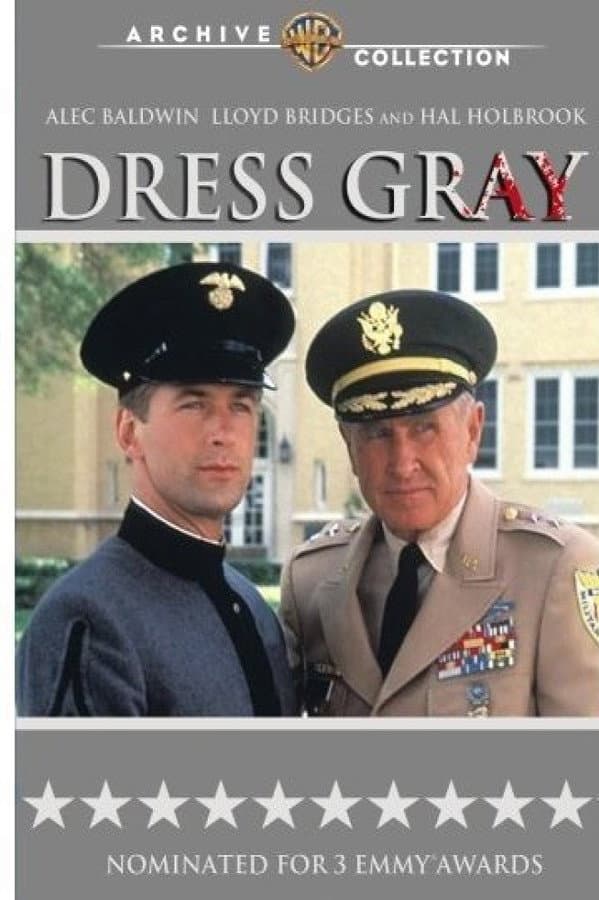
Dress Gray
1986 • Crime, Drama, Mystery
When a cadet at a military academy is found dead, the assumption is it was an accident. But the autopsy reveals that's not the case and that he's a homosexual and the last person he was with someone before he died and that someone is an academy upperclassman. The commandant wanting to protect the academy's good name tries to keep it quiet and hopefully no one will care about it. But the cadet comes from a prominent family and his father knows it couldn't have been an accident. And his sister knows one of the upper class men who knew his brother. And he learns the truth of her brother's death when he spoke to the academy doctor. Later when the commandant learns of this he orders the man brought to him and tells him to forget what he learned. But he sets out to find out the truth. At the same time the commandant gets some info that might implicate him.
Buy related books from Amazon
As an Amazon Associate I earn from qualifying purchases. Read the full disclosure.
Why you should read the novel
If the 1986 TV miniseries caught your eye, the novel Dress Gray by Lucian Truscott IV will keep you turning pages long after the credits would have rolled. This military academy mystery delivers raw authenticity, intricate plotting, and a gripping sense of place you simply can’t stream.
Truscott, a West Point graduate, channels first-hand insight into an immersive crime novel that explores honor, loyalty, and the cadet code with nuance. The book’s detailed campus culture, investigative twists, and moral stakes provide a richer, fuller story than any screen time allows—perfect for readers who love intelligent thrillers and realistic military fiction.
Choose the book to experience the complete West Point thriller: deeper character arcs, sharper social commentary, and an uncompromised narrative. Whether you prefer hardcover, paperback, ebook, or audiobook, reading Dress Gray offers the definitive, authoritative version of this acclaimed military mystery.
Adaptation differences
Curious about the differences between the Dress Gray book and TV series? The 1986 miniseries condenses the novel’s layered investigation, trimming academy-life subplots and merging multiple cadets and officers into composites. That faster pace improves accessibility on television but reduces the novel’s rich West Point world-building and procedural complexity.
In tone and content, the book is grittier. Truscott’s depictions of hazing, sexuality, and institutional power are more explicit and morally unsettling. Network standards in the TV adaptation soften language, violence, and adult themes, steering the story toward a cleaner, more conventional whodunit and away from the book’s sharper social critique.
Characterization also shifts noticeably in the adaptation vs. the novel. On the page, Ry Slaight’s interior doubts, conflicts with the cadet code, and ethical dilemmas unfold through tense introspection. On screen, inner turmoil becomes dialogue and action, while several relationships are simplified or reconfigured, narrowing the psychological depth that drives the book.
Finally, the resolution differs. The miniseries reorders key clues, streamlines motives, and presents clearer accountability to provide tidy closure. The novel’s endgame is darker and more ambiguous about institutional responsibility, leaving a lingering aftertaste that fuels discussion long after the last chapter—an impact the TV version only partially captures.
Dress Gray inspired from
Dress Gray
by Lucian Truscott IV