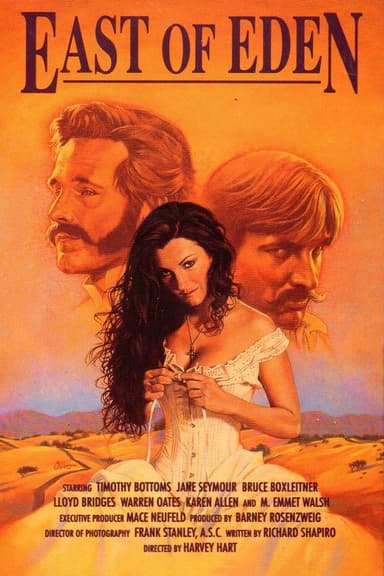
East of Eden
Drama
Spanning the years between the Civil War and World War I, East of Eden follows the intertwined destinies of the Trask and Hamilton families as generations repeat the biblical rivalry of Cain and Abel. Haunted by betrayal and the legacy of the manipulative Cathy Ames, brothers battle for love, approval, and redemption in California’s Salinas Valley.
Buy related books from Amazon
As an Amazon Associate I earn from qualifying purchases. Read the full disclosure.
Why you should read the novel
Before you stream the East of Eden TV adaptation, experience the power and nuance of John Steinbeck’s original novel. The book’s rich prose, layered symbolism, and immersive Salinas Valley setting deliver textures no screen can fully capture. Reading the source unlocks Steinbeck’s full moral vision—love, guilt, inheritance, and the timeless question of free will.
Steinbeck’s East of Eden offers expansive character psychology, from Adam and Charles to Cal and Aron, and the unforgettable Cathy/Kate. On the page, their motives, contradictions, and transformations unfold with intimate clarity. You’ll feel the stakes rise not just through events, but through the inner weather of conscience, shame, and the human longing to be chosen.
If you want the complete “timshel” experience—the linguistic puzzle, the philosophical debate, and its life-shaping implications—read the novel. It’s a literary classic that rewards close attention, revealing new insights on every revisit. Search for East of Eden by John Steinbeck, pick up the book, and let the original story speak for itself.
Adaptation differences
While the East of Eden TV miniseries aims for breadth, it necessarily condenses Steinbeck’s multigenerational canvas. Entire strands—especially extended Hamilton family arcs and regional digressions that anchor the Salinas Valley as a living character—are streamlined or abbreviated. The book’s slow-bloom structure and generational echoes gain cumulative force that episodic television can only sketch in highlights.
Cathy/Kate’s darkness is central in both versions, but broadcast standards and time constraints often soften or reframe her cruelty. The novel’s frank depictions of manipulation, sexuality, and violence are starker, making her malignancy—and its ripple effects—more unsettling on the page. Supporting figures who illuminate her motives and consequences receive fuller attention in the book.
The novel’s philosophical core—especially Lee’s “timshel” discussions with Samuel and Adam—runs deeper in print. The TV adaptation typically preserves key beats, including the famed deathbed “Timshel,” but compresses the linguistic and theological debate that gives the word its weight. Steinbeck’s authorial voice and autobiographical interludes, which braid personal memory with myth, are largely absent onscreen.
Character interiors differ markedly. In the book, Cal, Aron, and Abra wrestle with identity, idealization, and moral inheritance through introspection and nuanced dialogue. On TV, visual storytelling accelerates decisions and externalizes conflict, sometimes simplifying motives. Readers encounter a more complex Abra, a more psychologically textured Cal, and a broader moral landscape that clarifies how choice—not fate—shapes the Trask legacy.
East of Eden inspired from
East of Eden
by John Steinbeck