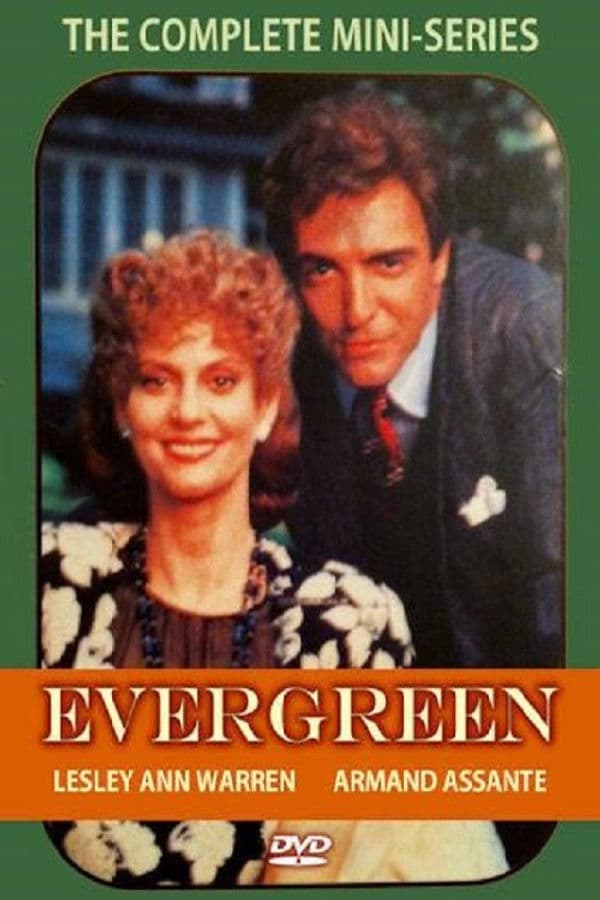
Evergreen
1985 • Drama, Family, Romance
Based on the novel by Belva Plain, covering a time span from 1909 to 1959. The story begins in New York's Lower East Side with the arrival of Polish-Jewish immigrant Anna (Lesley Ann Warren). At first employed as a humble seamstress, Anna is whisked into a whole new world when she becomes the wife of the enterprising Joseph Friedman (Armand Assante), who eventually becomes a wealthy Westchester contractor. Even so, Anna's heart belongs to Paul Lerner (Ian Shane), the son of the prosperous Fifth Avenue family which employs her relatives. In 1918, Anna gives birth to Paul's daughter, allowing Joseph to believe that he is the father. The secret surrounding Anna's child will lead to a daunting and frequently heartbreaking chain of events, culminating decades later in the newly formed state of Israel, where Anna's grandson Eric hopes to "find himself" -- and ends up finding more than he bargained for.
Buy related books from Amazon
As an Amazon Associate I earn from qualifying purchases. Read the full disclosure.
Why you should read the novel
Choose Belva Plain’s Evergreen novel for an experience the screen can’t match. The book offers layered character development, intimate inner lives, and the slow-burn momentum of a classic immigrant family saga that rewards every page.
On the page, Plain’s evocative prose paints New York’s tenements, parlors, and boardrooms with rich historical texture. Themes of identity, sacrifice, class mobility, and motherhood unfold with nuance, inviting thoughtful reflection long after the final chapter.
If you loved the Evergreen (1985) miniseries, reading the novel delivers the full, uncut story in Belva Plain’s own voice. Discover deeper motivations, fuller backstories, and resonant emotions—then continue the journey with the sequels The Golden Cup and Tapestry.
Adaptation differences
The Evergreen (1985) TV miniseries streamlines Belva Plain’s expansive novel to fit limited runtime. Timelines are compressed, life stages move faster, and several subplots are trimmed to keep the focus on marquee moments and romance-driven beats.
Character depth is richer in the book. The novel lingers on interiority, moral ambiguity, and the ripple effects of choices across generations. Onscreen, some supporting characters are combined or simplified, while the prose gives them distinct voices and arcs.
Cultural and historical texture runs deeper on the page. The novel immerses readers in the realities of immigrant neighborhoods, work, faith, and social climbing in early twentieth-century New York, whereas the adaptation emphasizes elegant period visuals over granular day-to-day detail.
Tone and resolution also diverge. The series favors self-contained, emotionally heightened crescendos, while the book balances sweeping drama with quieter, bittersweet notes and leaves space that connects naturally to the broader family saga in subsequent novels.
Evergreen inspired from
Evergreen
by Belva Plain