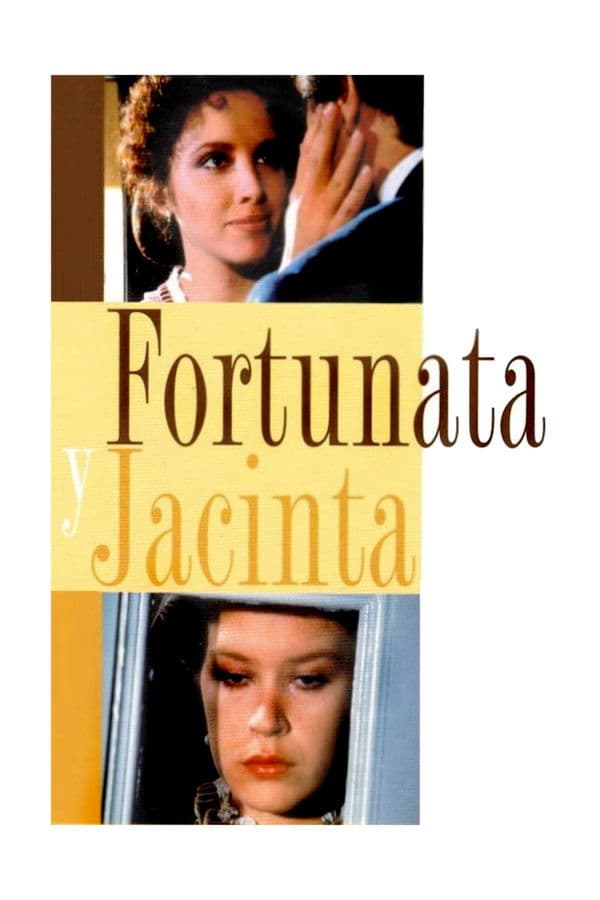
Fortunata and Jacinta
1980 • Drama • NR
The aristocrat Juan de Santa Cruz meets Fortunata, a girl of humble origins, and a passionate love arises between them; but his mother decides to marry him to her niece Jacinta.
Buy related books from Amazon
As an Amazon Associate I earn from qualifying purchases. Read the full disclosure.
Why you should read the novel
Before you watch the 1980 TV series Fortunata y Jacinta, read the Fortunata and Jacinta book by Benito Pérez Galdós—the definitive, immersive telling from a master of Spanish realism.
On the page, you’ll find layered interior monologues, sharper social satire, and a panoramic Madrid of the Restoration era—nuances the screen can only hint at. The novel’s rich psychology and intricate class portrait reward slow reading in ways no adaptation can match.
Widely available in English translation, this classic Spanish novel is perfect for literature lovers, book clubs, and students. Choose the book to experience the full depth, irony, and humanity of Galdós’s vision, exactly as he intended.
Adaptation differences
Scope and structure: Galdós’s multi-part novel spans years and weaves long digressions about Madrid’s society and economy. The TV adaptation condenses events into limited episodes, compressing chronology, combining scenes, and trimming peripheral threads to sustain momentum.
Characterization: The book devotes substantial space to secondary figures—such as Mauricia “la dura,” Guillermina Pacheco, Ido del Sagrario, and Evaristo Feijoo—building complex motives and contradictions. On screen, several arcs and backstories are reduced or simplified, shifting emphasis toward the central triangle.
Narrative voice and themes: The novel’s omniscient narrator uses irony and free indirect style to reveal interior lives and social critique. Without that guiding voice, the series relies on dialogue and performance, often accentuating romance and melodrama over the book’s essayistic commentary and satirical bite.
Setting and emphasis: Galdós maps 19th‑century Madrid with encyclopedic detail—markets, streets, customs, and class codes. The adaptation recreates key locations but inevitably narrows the city’s breadth, occasionally reordering or refocusing episodes to foreground major plot beats while softening some of the novel’s discursive richness.
Fortunata and Jacinta inspired from
Fortunata and Jacinta
by Benito Pérez Galdós