Romance of the Three Kingdoms
2009 • Action & Adventure, Animation, Drama • TV-PG
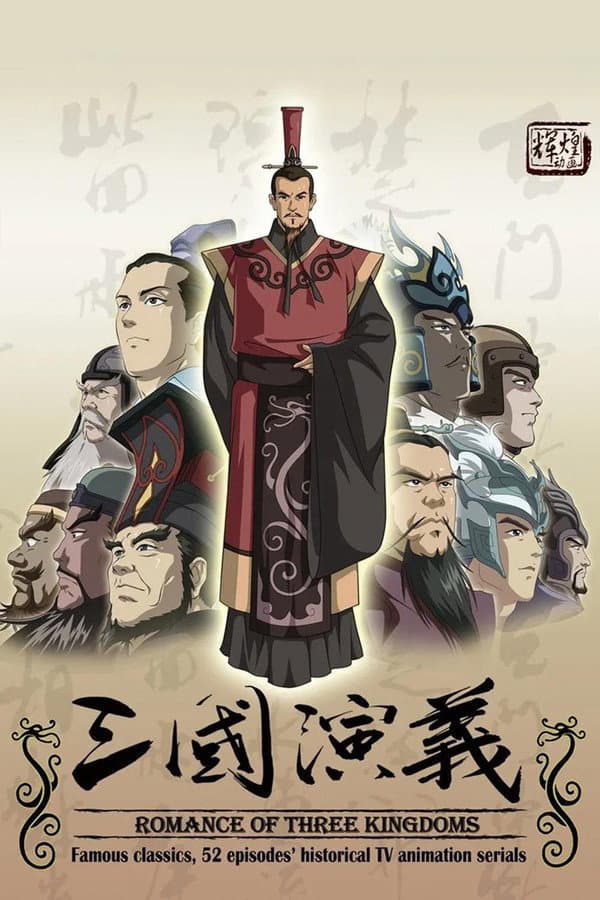
Romance of the Three Kingdoms is a 2009 animated television series joint produced by the Beijing Huihuang Animation Company of China and Future Planet of Japan. It was broadcast in Japan starting April 2010.
Buy related books from Amazon
As an Amazon Associate I earn from qualifying purchases. Read the full disclosure.
Why you should read the novels
Experience the full power of Romance of the Three Kingdoms as Luo Guanzhong intended. The novel’s sweeping saga of strategy, loyalty, and ambition offers richer context, deeper character development, and countless scenes the TV series condenses or omits. English translations preserve famous speeches, poems, and proverbs that illuminate the culture behind the battles.
Reading the book unlocks the grand design of the era—why alliances rose and fell, how brilliant ruses worked, and what motivated legends like Zhuge Liang, Cao Cao, Liu Bei, and Sun Quan. Acclaimed English editions provide helpful notes, maps, and historical background, making this classic both accessible and endlessly rewarding for new and returning readers.
If you want the definitive Three Kingdoms experience, start with the source. The novel’s layered storytelling, moral complexity, and unforgettable set pieces shine brighter on the page than on any screen. Choose the book to absorb the epic at your own pace—and discover scenes, lines, and insights you won’t find in the TV adaptation.
Adaptation differences
Scope and pacing are the biggest differences between the Romance of the Three Kingdoms (2009) TV series and the novel. The book spans hundreds of chapters and an enormous cast, while the adaptation condenses timelines, merges or drops minor figures, and reorders events for clarity. This streamlining helps television flow but inevitably trims political subplots and detailed campaigns that the book explores.
Characterization and moral framing also diverge. Luo Guanzhong’s novel tends to idealize Liu Bei’s Shu and cast Cao Cao as a ruthless antagonist, reinforcing a classic moral arc. The TV series often strikes a more balanced tone, deepening Cao Cao’s complexity, humanizing Zhuge Liang, and showing flaws in heroes the novel sometimes sanctifies—shifting sympathies and reshaping how viewers judge each faction.
Tone and texture change with the medium. The novel features poetry, omens, prophecies, and larger-than-life set pieces—Guan Yu’s deification, Zhuge Liang’s uncanny foresight, and theatrical speeches. The adaptation typically reduces supernatural elements, modernizes dialogue, and favors pragmatic realism. As a result, certain iconic ruses and lyrical passages become shorter, more literal, or are represented visually rather than through extended narration.
Battles and outcomes are framed differently. On the page, stratagems unfold through letters, counsel scenes, and long tactical explanations; on screen, they’re compressed into action-forward sequences with different emphases. Some arcs—like the rise of the Sima clan or the later decline of Shu—receive redistributed focus, and specific conclusions may land at different narrative milestones than the novel’s sweeping endgame, altering the story’s ultimate resonance.
Romance of the Three Kingdoms inspired from
Romance of the Three Kingdoms
by Luo Guanzhong
Records of the Three Kingdoms (Sanguozhi)
by Chen Shou