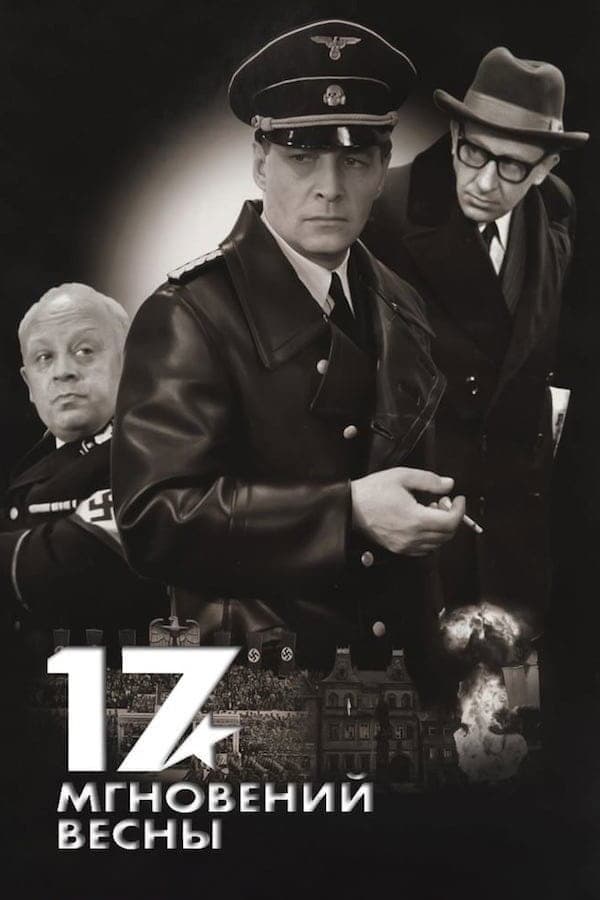
Seventeen Moments of Spring
1973 • Drama, War & Politics
A Soviet spy is tasked with disrupting the negotiations between Karl Wolff and Allen Dulles taking place in Switzerland, aimed at forging a separate peace between Germany and the Western Allies.
Buy related books from Amazon
As an Amazon Associate I earn from qualifying purchases. Read the full disclosure.
Why you should read the novel
Choose the Seventeen Moments of Spring novel by Yulian Semyonov to experience the full depth behind the legendary TV series. The book immerses you in Stierlitz’s mind, delivering layered psychology, authentic tradecraft, and historical nuance the screen can only hint at.
Semyonov’s prose blends taut suspense with documentary realism—archival-style details, political context, and quiet moral dilemmas that elevate this spy story into a Cold War–era classic. If you value complex characters, razor-sharp observation, and the texture of late‑war Europe, the novel is indispensable.
Reading the original Seventeen Moments of Spring book gives you richer stakes, clearer motivations, and a broader view of the final months of WWII. For fans of John le Carré and Alan Furst, this source text is the definitive way to understand Stierlitz and the world he navigates.
Adaptation differences
The TV series is remarkably faithful in spirit, but the novel supplies far more interiority. Semyonov’s text leans on internal monologue, documentary-style citations, and essayistic asides that map motives and power structures; on screen, much of this becomes concise dialogue or narrator summaries.
Structure and pacing diverge. The book’s chronology allows for digressions into background, intelligence methods, and historical context, while the series condenses or reorders events to build episode-by-episode suspense. Several investigative steps and intermediate leads appear in greater detail on the page and are streamlined on television.
Characterization is fuller in the novel. Secondary figures—diplomats, SS officials, handlers, and informants—often receive expanded backstories and clearer motivations in print. The series emphasizes visual tension and key confrontations, so some personalities are sharpened or combined, and ideological shades are presented with the clarity expected of prime-time historical drama.
Tone and texture differ as well. Semyonov’s book sustains a denser mesh of political nuance, specialized terminology, and procedural minutiae that reward close reading. The adaptation translates this into mood—iconic narration, measured performances, and memorable set pieces—while compressing appendical context and historical commentary that the novel presents more explicitly.
Seventeen Moments of Spring inspired from
Seventeen Moments of Spring
by Yulian Semyonov