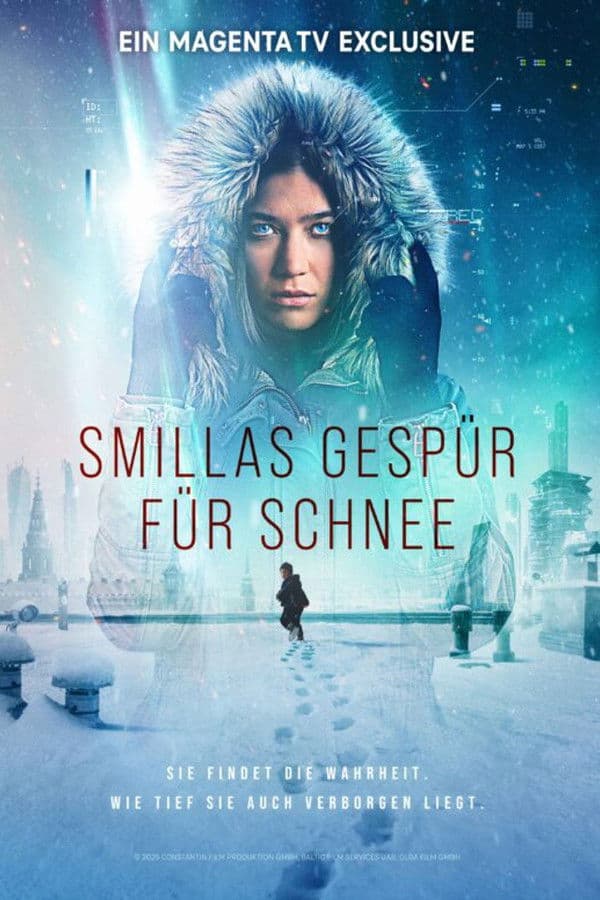
Smillas Gespür für Schnee
2025 • Crime, Drama, Mystery, Sci-Fi & Fantasy
Set in Copenhagen in 2040 and tells the story of Smilla Jaspersen (Filippa Coster-Waldau), who lives in a near-future surveillance state threatened by an impending energy crisis.
Buy related books from Amazon
As an Amazon Associate I earn from qualifying purchases. Read the full disclosure.
Why you should read the novel
If the icy intrigue of Smillas Gespür für Schnee (2025) draws you in, start with the source: Miss Smilla's Feeling for Snow by Peter Høeg. The novel delivers the raw, intimate perspective of Smilla Jaspersen—her voice, her science, and her grief—in a way no screen can fully capture. Experience the original Nordic noir classic that launched a global fascination.
On the page, Høeg’s meticulous language turns snow, ice, and urban Copenhagen into living forces. Smilla’s taxonomy of snow and forensic insight propel a mystery rich with cultural depth, Greenlandic-Danish history, and philosophical edge. Readers gain layers of motivation, context, and nuance that adaptations often streamline.
Read the novel before you watch. Buy Miss Smilla’s Feeling for Snow, download the ebook, or listen to the audiobook to savor Høeg’s tense, atmospheric prose. Perfect for fans of Nordic noir, literary thrillers, and character-driven mysteries seeking the definitive version of Smilla’s story.
Adaptation differences
Note on availability: Detailed episode information for the 2025 TV series was not public at the time of writing. That said, the clearest difference between most screen adaptations and Peter Høeg’s novel is perspective. The book lives inside Smilla’s head—her precise, often wry inner voice, scientific observations about ice and snow, and sharp moral compass—while television typically externalizes this through dialogue and visuals, inevitably compressing her forensic lexicon and introspective depth.
Structure and pacing often diverge. The novel layers Copenhagen investigation with Greenland memories and meticulous procedural detail, building tension through reflection as much as action. A series usually streamlines chronology, sharpens cliffhangers, condenses secondary characters, and simplifies aspects of the corporate–scientific conspiracy to fit season arcs and episodic beats, altering how revelations land compared with the book.
Cultural nuance can shift. On the page, Høeg explores Greenlandic-Danish colonial history, Inuit identity, socioeconomic marginalization, and language itself. Television frequently foregrounds spectacle—Arctic vistas, chases on ice, and moody cityscapes—while trimming sociopolitical exposition or multilingual texture (Greenlandic, Danish, and translation choices) that give the novel its distinctive ethical and cultural resonance.
Tone and resolution may change. The book’s bleak atmosphere, moral ambiguity, and quietly devastating ending often become clearer motivations, tidier villainy, or bigger action beats in TV. Violence and romance can be heightened, while scientific detail and contemplative passages recede, shifting how Smilla’s independence, vulnerability, and agency register when compared to the literary original.
Smillas Gespür für Schnee inspired from
Miss Smilla's Feeling for Snow
by Peter Høeg