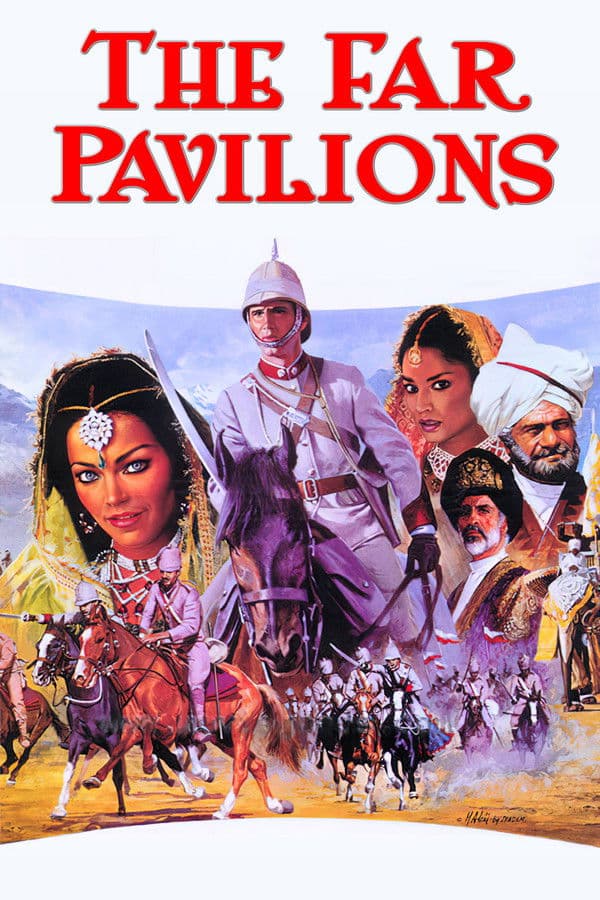
The Far Pavilions
1984 • Action & Adventure, Drama
Adapted from M.M. Kaye's best-selling novel, this dramatic HBO miniseries follows two star-crossed lovers -- the young British officer Ash (Ben Cross) and the betrothed princess Anjuli (Amy Irving) -- as they face daunting odds in their quest to be together. Set in India during the time of the British Raj, this haunting (and BAFTA-nominated) love story features spectacular scenery and an epic saga of battle, treachery and intrigue.
Buy related books from Amazon
As an Amazon Associate I earn from qualifying purchases. Read the full disclosure.
Why you should read the novel
Before pressing play on the 1984 miniseries, discover the source that started it all: The Far Pavilions by M. M. Kaye. This sweeping historical novel immerses you in the British Raj with a richness of culture, language, and atmosphere that screen adaptations can only suggest. If you crave a deep, transporting read, the book delivers an unforgettable journey.
The Far Pavilions novel gives you fuller character psychology, layered politics, and a living, breathing India—mountain passes, princely courts, and frontier posts—rendered with meticulous detail. Kaye’s prose lets you experience Ash and Anjuli’s love story alongside the tensions of empire, identity, and duty, all with the nuance that comes from hundreds of pages of world-building.
If you’re searching for an epic historical romance with substance, pick up The Far Pavilions in paperback, ebook, or audiobook. Reading the M. M. Kaye classic provides context, emotion, and historical insight beyond the limits of any TV runtime—making the novel the definitive way to experience this story.
Adaptation differences
The book’s scale and depth far exceed the miniseries. M. M. Kaye devotes expansive chapters to social customs, languages, and the political tensions of the British Raj and the Afghan frontier. The adaptation, constrained by runtime, condenses this world-building, streamlining settings and historical context to keep the plot moving.
Characterization is also more layered in the novel. Ashton Pelham-Martyn’s bicultural identity, loyalties, and inner conflicts are explored through extensive internal reflection, while Anjuli’s agency, fears, and resilience receive sustained attention. On screen, several motivations are simplified, and some secondary characters are reduced or combined, shifting how relationships develop and resolve.
Plot structure and pacing differ notably. The novel’s court intrigue, overland journeys, and military campaigns unfold gradually, with intricate subplots and political maneuvering. The miniseries compresses timelines, reorders events for dramatic beats, and trims or omits episodes that do not directly serve the central romance, resulting in a more linear, cliffhanger-driven narrative.
Tone and themes shift in adaptation. Kaye’s text balances epic romance with a critical, often ambivalent view of imperial power, offering granular detail about the Second Anglo-Afghan War and frontier life. The series emphasizes spectacle and melodrama, softening complexities and cultural nuance. For the most complete themes, context, and emotional resonance, the novel remains the authoritative version of The Far Pavilions.
The Far Pavilions inspired from
The Far Pavilions
by M. M. Kaye