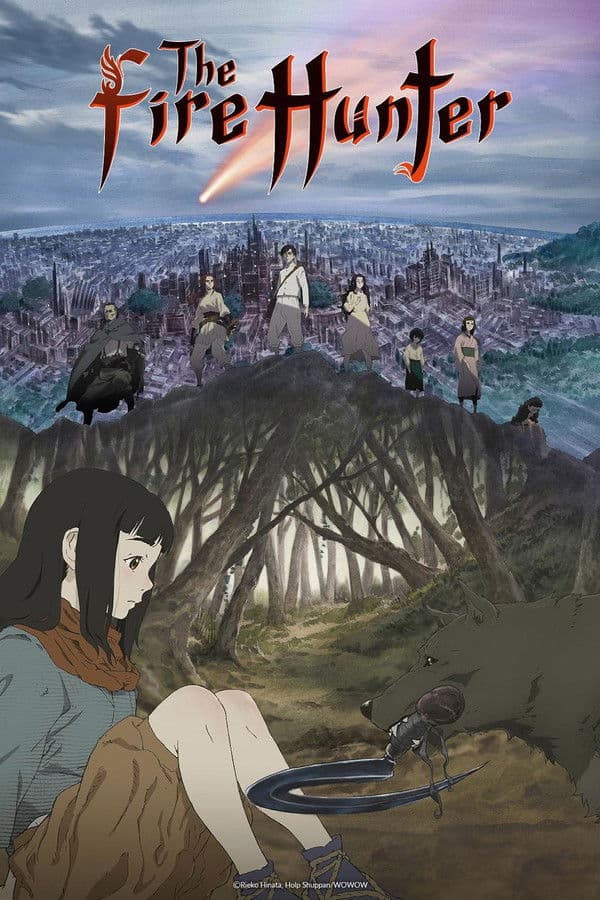
The Fire Hunter
2023 • Animation, Drama, Mystery, Sci-Fi & Fantasy • TV-14
Outside the magical barriers lies a world overrun by fiery beasts known as Flame Demons, and the only ones who can protect humanity are the Fire Hunters. In the dark woods where the beasts roam is where Touko, a young villager, is rescued from attack by one of these skilled trackers, Koushi. But their meeting was no accident, and a new destiny begins.
Buy related books from Amazon
As an Amazon Associate I earn from qualifying purchases. Read the full disclosure.
Why you should read the novel
If The Fire Hunter (Hikari no Ou) gripped you on screen, the original novel series by Rieko Hinata—brought to life with evocative illustrations by Akihiro Yamada—delivers a deeper, more textured journey. On the page, its post-apocalyptic folklore, fragile societies, and perilous hunts breathe with contemplative quiet and layered symbolism that television can only suggest.
While an official English translation has not been released as of now, keeping an eye on licensing news can pay off. Reading the source novels offers more intimate character interiority, nuanced worldbuilding, and subtle thematic echoes—letting you experience The Fire Hunter exactly as the author conceived it, at the intended pace and scope.
Support the original by seeking legitimate imports, following publisher announcements, and requesting an English edition from your favorite imprints. When English volumes arrive, you’ll be first to uncover the unabridged lore, carefully seeded mysteries, and authorial voice that make The Fire Hunter novel series a uniquely absorbing read—far beyond what any adaptation can capture.
Adaptation differences
Differences between The Fire Hunter anime and novel begin with structure and pacing. The series intercuts dual leads and compresses multi-chapter arcs for momentum, while the books unfold more linearly and patiently, letting tension and lore accumulate through deliberate, travelogue-like progression. This shift reshapes how revelations land and how the world’s rules sink in.
Worldbuilding and exposition also diverge. On TV, political factions, industrial remnants, and mythic elements are externalized through visuals and dialogue for clarity. The novels, by contrast, layer details through introspective passages and atmosphere, rewarding close reading with quiet clues, cultural texture, and a stronger sense of ecological and spiritual logic.
Character focus changes in adaptation. The anime privileges screen-ready beats—sharper conflicts, streamlined relationships, and reduced inner monologue—sometimes merging or sidelining minor figures. The books dwell longer in characters’ heads, tracing motives, fears, and small decisions that cumulatively alter destinies, yielding a subtler emotional arc and different emphases among the supporting cast.
Coverage and endpoint naturally differ. A TV season must select a stopping point, so certain subplots are deferred or reordered, and anime-original connective scenes appear under series composition by Mamoru Oshii. Key revelations may arrive earlier or later than in print, altering suspense. Reading the novels provides the complete arc and authorial cadence, revealing how themes and mysteries interlock beyond the adaptation’s timeframe.
The Fire Hunter inspired from
The Fire Hunter (novel series)
by Rieko Hinata, Akihiro Yamada (illustrator)