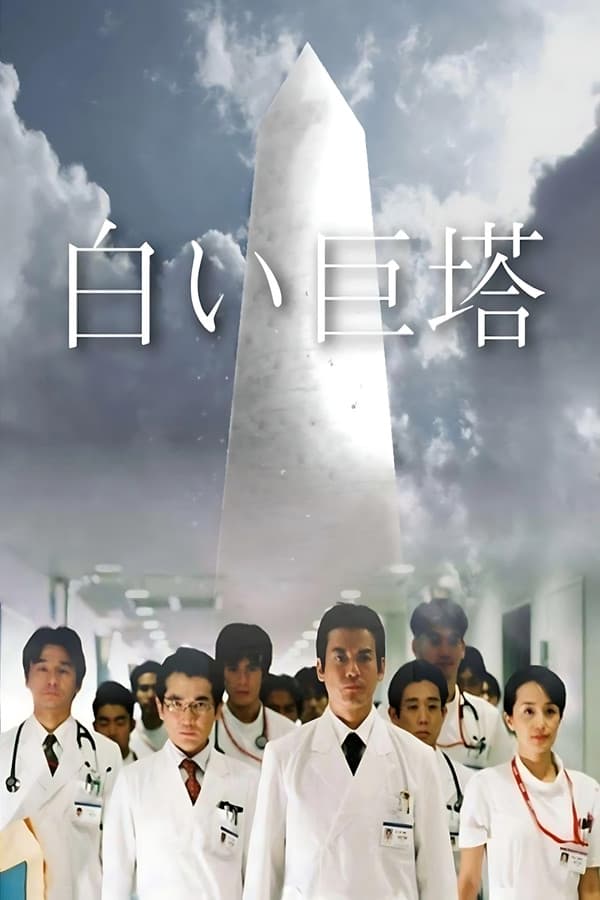
The Great White Tower
2003 • Drama
Two surgeons with contrasting objectives are asked to work together in a city hospital. While one of them strives to achieve fame and power through his work, the other wants to save human lives.
Buy related books from Amazon
As an Amazon Associate I earn from qualifying purchases. Read the full disclosure.
Why you should read the novel
Discover Toyoko Yamazaki’s landmark novel The Great White Tower, the source that powered the acclaimed 2003 TV drama. On the page, the rivalries, ethical dilemmas, and professional ambitions at a university hospital unfold with a depth and nuance no screen can fully capture. If you’re drawn to the series’ intensity, the novel’s layered storytelling will immerse you even further.
Reading the book gives you the original social and historical context behind the conflicts that shape the story. Yamazaki examines Japan’s medical establishment against the backdrop of rapid economic growth, academic hierarchies, and shifting public expectations. That richer context turns every operating room victory and courtroom setback into part of a much larger, thought‑provoking portrait of power and responsibility.
For readers who love character‑driven drama, The Great White Tower novel delivers unmatched interiority: private doubts, calculated compromises, and hard‑won convictions. Its precise prose, investigative detail, and moral complexity make it an enduring classic—and the definitive way to experience this saga before (or instead of) watching any adaptation.
Adaptation differences
Time and setting: The 2003 TV series updates the look and feel of the hospital environment to its contemporary moment, emphasizing modern equipment and procedures. The novel is rooted in an earlier era’s professional culture and postwar social currents, giving the same power struggles a different historical weight and texture.
Structure and pacing: On the page, The Great White Tower unfolds in an expansive, two‑track sweep—academic politics and a malpractice dispute—building pressure chapter by chapter. The adaptation streamlines events, intercuts plotlines for momentum, and trims or compresses subplots to fit episodic rhythms, which can sharpen thrills but reduce the novel’s slow‑burn accumulation of detail.
Character focus and perspective: Yamazaki’s novel ranges widely across departments, administrators, patients, families, and legal teams, layering multiple viewpoints and interior monologues. The series concentrates attention on the central rivals and a tighter circle around them. As a result, some supporting figures are merged, rebalanced, or given briefer arcs, shifting how certain motives and moral gray areas register with the audience.
Tone and thematic emphasis: The book’s investigative rigor and social critique are sustained through careful exposition, professional minutiae, and a nuanced look at institutions. The adaptation heightens dramatic confrontations, accelerates courtroom exchanges, and foregrounds visual tension in surgeries and meetings. Key beats may land with greater immediacy on screen, while the novel preserves greater ambiguity, systemic context, and the intricate cause‑and‑effect that drives the story’s ethical stakes.
The Great White Tower inspired from
The Great White Tower
by Toyoko Yamazaki