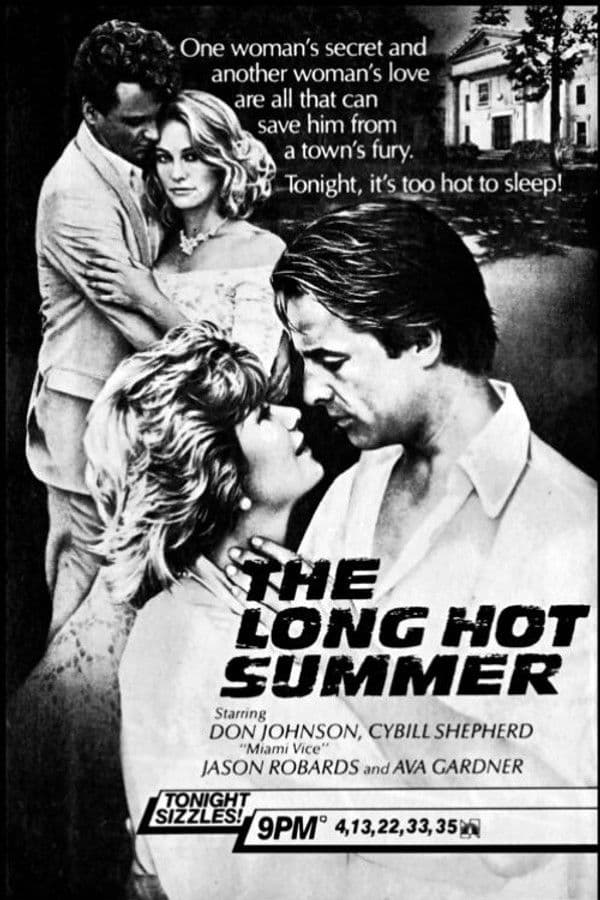
The Long Hot Summer
1985 • Drama
When drifter Ben Quick arrives in a small Mississippi town, Will Varner, a family patriarch, sees Ben as a better choice to inherit the family business than his only son, Jody. Will therefore tries to push Ben and his daughter Clara into marriage. Clara is initially reluctant to court Ben, and Jody senses that Ben threatens his position.
Buy related books from Amazon
As an Amazon Associate I earn from qualifying purchases. Read the full disclosure.
Why you should read the novels
Before pressing play on The Long Hot Summer (1985), discover the original William Faulkner source material that inspired it. Reading The Hamlet, Barn Burning, and Spotted Horses delivers the raw Southern Gothic textures, razor-edged irony, and social satire the screen can only hint at. These works are a cornerstone of American literature and reveal the full complexity behind the drama you see on TV.
Faulkner’s storytelling is immersive and unforgettable: tangled family legacies, ruthless ambitions, and the moral weight of community pressures unfold in language that’s electric with place and history. In print, you’ll meet the Varners, the Snopes clan, and the denizens of Yoknapatawpha County in their richest, most nuanced forms—far beyond the compressed arcs of a miniseries.
If you love Southern atmosphere, slow-burn tension, and layered characters, the books are the definitive experience. Reading The Hamlet, Barn Burning, and Spotted Horses gives you deeper themes, sharper stakes, and Faulkner’s unmatched voice—so when you finally watch the adaptation, you’ll catch every echo and appreciate what was changed, softened, or left out.
Adaptation differences
Scope and focus shift dramatically from page to screen. Faulkner’s texts sprawl across Yoknapatawpha County with many interlocking stories, while the 1985 miniseries centralizes a single charismatic outsider, streamlining the narrative into a romance- and rivalry-driven plot. The show’s clear protagonist focus contrasts with Faulkner’s ensemble dynamics and roving, panoramic storytelling.
Characterization is reconfigured. The adaptation crafts Ben Quick as a seductive, reformable antihero, whereas Faulkner’s source materials distribute moral ambiguity among multiple figures—especially the Snopeses—without a guaranteed redemption arc. Will Varner is softened into a more sentimental patriarch, and Clara Varner functions as a romantic counterpart that reframes (and in places replaces) the role and aura of Eula Varner from The Hamlet, shifting themes of sexuality, power, and community perception.
Plot elements are condensed and reassigned. Motifs from Barn Burning become a rumor-laden backstory shaping Ben Quick’s reputation, rather than centering the father–son moral crisis that defines Faulkner’s story. Spotted Horses’ chaotic horse-trading episode is reduced to selective beats or tonal flavor, and The Hamlet’s intricate Snopes ascent and village economics are simplified to highlight personal conflicts, inheritance struggles, and courtship.
Tone, structure, and setting are modernized for television. Faulkner’s fragmented perspectives, irony, and dense prose yield to a linear, glossy 1980s miniseries cadence with cleaner dialogue and heightened melodrama. The adaptation emphasizes romance and resolution over Faulkner’s thornier social critique—softening class commentary, muting the grimmer edges, and trading literary ambiguity for accessible, high-heat drama.
The Long Hot Summer inspired from
The Hamlet
by William Faulkner
Spotted Horses
by William Faulkner
Barn Burning
by William Faulkner