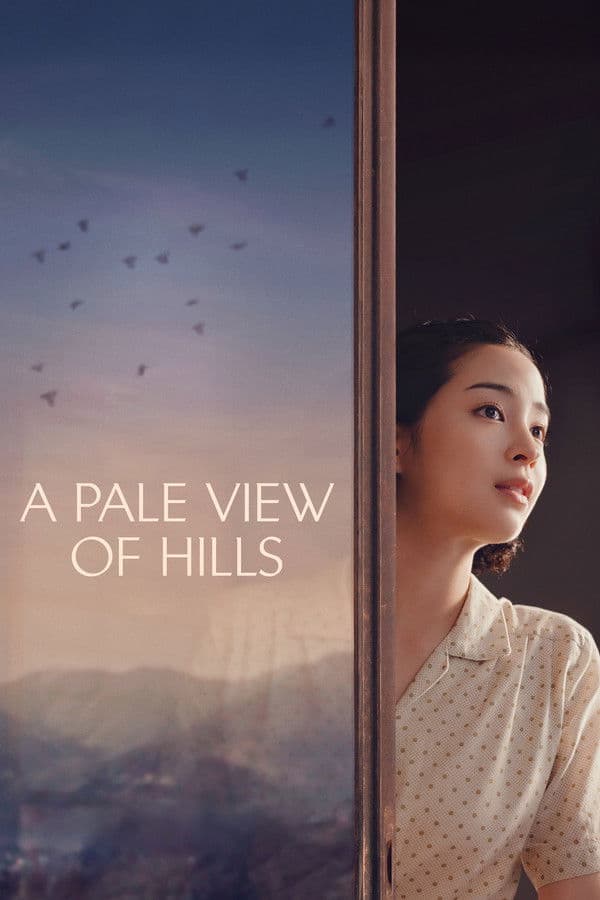
A Pale View of Hills
2025 • Drama, History
Dual timelines explore a Japanese widow's memories spanning post-war Nagasaki in 1950s and England during 1980s Cold War era, unraveling secrets that intertwine her past and present experiences across borders.
Runtime: 2h 3m
Buy related books from Amazon
As an Amazon Associate I earn from qualifying purchases. Read the full disclosure.
Why you should read the novel
Before you watch the 2025 movie adaptation of A Pale View of Hills, experience the original novel by Nobel laureate Kazuo Ishiguro. The book’s quiet power, haunting atmosphere, and subtle psychological mystery reward close reading in ways no screen version can fully replicate.
Ishiguro’s prose invites you inside Etsuko’s mind, where memory, guilt, and cultural dislocation blur together. The novel’s ambiguous storytelling and unreliable narration are essential to its impact, making the A Pale View of Hills book a must-read for fans of literary fiction, Japanese postwar settings, and nuanced character studies.
If you are searching for what to read before the movie, choose the source material itself. Reading A Pale View of Hills unlocks hidden layers, gives context for every adaptation choice, and ensures you appreciate the themes behind the plot rather than just the plot points.
Adaptation differences
At the time of writing, detailed information about the 2025 adaptation is limited. Readers can expect one major difference to involve point of view: the novel’s first-person, unreliable narration filters every scene through Etsuko’s shifting memories. A film will likely externalize that interiority with visual cues, voiceover, or added exposition, changing how ambiguity lands and shaping perceived differences between the A Pale View of Hills movie and book.
Structure is another likely change. The book moves fluidly between present-day England and postwar Nagasaki with deliberate ellipses and unresolved transitions. To maintain pacing, the movie may streamline timelines, create clearer chapter breaks, or re-order events for clarity, which can reduce the novel’s productive uncertainty and alter the rhythm of revelations.
Character emphasis often shifts in adaptations. Secondary figures such as Sachiko, Mariko, and Keiko may be combined, expanded, or simplified to fit a feature-length runtime. Motivations that the book leaves implied could be stated outright, altering how themes of motherhood, grief, survivor’s guilt, and cultural displacement resonate across scenes.
Tone and theme delivery may also diverge. Ishiguro’s prose cultivates silence and suggestion; a film might use music, flashbacks, or explicit dialogue to communicate trauma and memory. For audiences comparing differences between the A Pale View of Hills movie and book, reading the novel preserves its delicate ambiguities, moral complexity, and the unsettling gaps that make its mystery endure.
A Pale View of Hills inspired from
A Pale View of Hills
by Kazuo Ishiguro