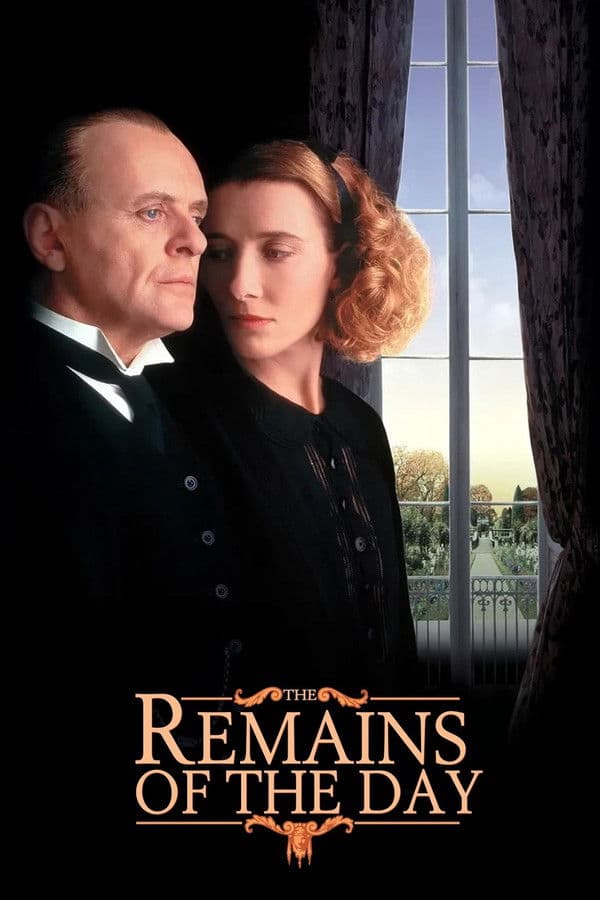
The Remains of the Day
1993 • Drama, Romance • PG
A rule-bound head butler's world of manners and decorum in the household he maintains is tested by the arrival of a housekeeper who falls in love with him in post-WWI Britain. The possibility of romance and his master's cultivation of ties with the Nazi cause challenge his carefully maintained veneer of servitude.
Runtime: 2h 14m
Buy related books from Amazon
As an Amazon Associate I earn from qualifying purchases. Read the full disclosure.
Why you should read the novel
Before pressing play, consider opening the Booker Prize–winning novel The Remains of the Day by Kazuo Ishiguro. The book’s first-person voice pulls you into Stevens’s inner world—his memories, evasions, and quiet revelations—in ways no screen can fully replicate. If you’re seeking a richer, more intimate experience of the story’s themes of duty, regret, and identity, the novel is the definitive source.
Reading the book offers unparalleled access to Ishiguro’s subtle craft: the controlled, elegant prose; the layered irony; and the gradual unmasking of a narrator who doesn’t always see himself clearly. The Remains of the Day book invites reflection at your own pace, rewarding attentive readers with insights that emerge line by line, page by page.
For fans of historical fiction and literary classics, choosing the novel over the movie means discovering the emotional architecture behind the adaptation. Explore the original context, the complex moral landscape of prewar Britain, and the quiet heartbreak of a life shaped by service. Experience the depth that made the novel a landmark of modern literature.
Adaptation differences
The novel is an intimate first-person reminiscence, filtered entirely through Stevens’s precise, evasive narration. The film necessarily shifts to an external, third-person vantage, capturing restraint visually but softening the novel’s exquisite play between what Stevens says and what he cannot admit.
Ishiguro structures the book around a six-day motoring trip, with digressions and associative memories triggered by roadside encounters and Miss Kenton’s letters. The movie intercuts the 1930s and 1950s more linearly and compresses the journey’s comic detours and village interludes, streamlining the timeline for cinematic clarity.
On the page, key ideas—especially Stevens’s definition of “dignity,” class ideology, and professional identity—are developed through sustained reflection and nuanced irony. The adaptation foregrounds the repressed romance and house politics, while condensing secondary threads: Mr. Farraday’s “banter” motif, broader political debates, and some of Lord Darlington’s contextual shading receive less emphasis.
The endings differ in tone and texture. The novel culminates on the Weymouth seafront, where Stevens’s private resolution unfolds against the fading day, emphasizing interior change. The film reshapes this with a poignant bus-stop farewell and a closing sequence at Darlington Hall (including the trapped pigeon), offering a visual metaphor and a more overt, cinematic cadence.
The Remains of the Day inspired from
The Remains of the Day
by Kazuo Ishiguro