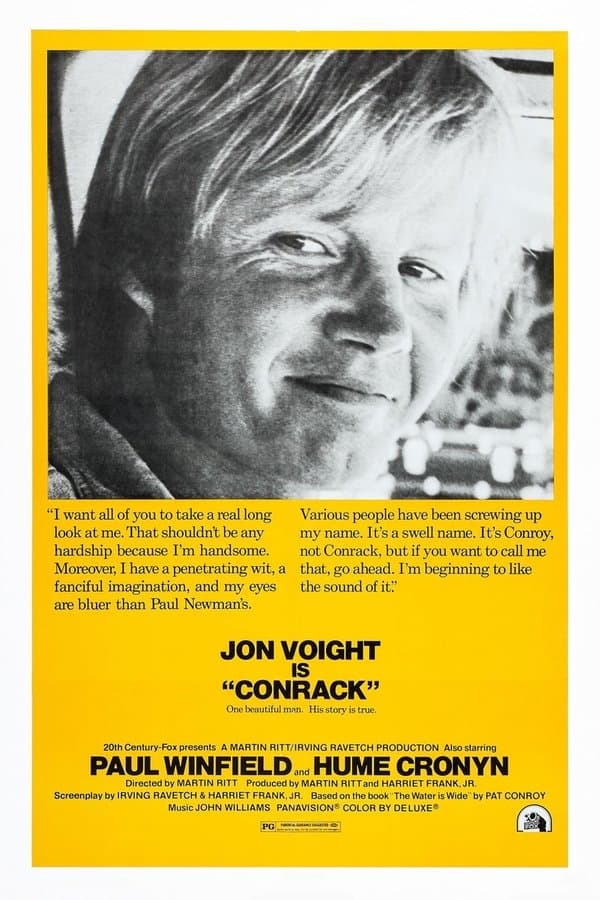
Conrack
1974 • Drama • PG
A young, white school teacher is assigned to Yamacraw Island, an isolated fishing community off the coast of South Carolina, populated mostly by poor black families. He finds that the basically illiterate, neglected children there know so little of the world outside their island.
Runtime: 1h 46m
Buy related books from Amazon
As an Amazon Associate I earn from qualifying purchases. Read the full disclosure.
Why you should read the novel
Choose The Water Is Wide by Pat Conroy to experience the real story behind Conrack. Conroy’s memoir immerses you in the Gullah community, the Lowcountry’s tides, and the classroom’s daily triumphs and setbacks. His candid voice and lyrical prose illuminate education, poverty, and resilience with a depth no two-hour film can match.
Reading the book offers richer context, fuller personalities, and the unfiltered reflections of a teacher confronting systemic neglect. You will meet students, families, and administrators in their full complexity, learn the history shaping the island, and witness how small breakthroughs truly happen. It’s the authentic, primary source that inspired the movie.
If you’re searching for an inspiring education book, a Southern coastal memoir, or a powerful true story, The Water Is Wide delivers. Discover the nuance the movie can only suggest, savor Pat Conroy’s storytelling, and let the original work guide you beyond the screen.
Adaptation differences
Conrack (1974) compresses and softens Pat Conroy’s memoir, The Water Is Wide. The film leans into an uplifting teacher-story arc, while the book presents a frank, often unsettling critique of institutional failures and racial inequities. The memoir’s introspection and moral ambiguity are necessarily trimmed for a more streamlined cinematic journey.
Characterization differs notably. In the book, administrators, colleagues, and community figures appear with layered motivations and contradictions; the film often merges or simplifies them into composite figures to keep the plot moving. Conroy’s own missteps and blind spots, explored candidly on the page, are downplayed, making the screen version feel more like a straightforward hero narrative.
Scope and detail shift as well. The Water Is Wide dwells on day-to-day classroom realities, bureaucratic clashes, and the texture of Gullah culture and language, providing historical and social context. Conrack condenses timelines, accelerates student progress, and reduces cultural nuance, prioritizing emotional beats and accessible set pieces over granular reportage.
The endings diverge in tone. While both the book and the film acknowledge consequences for Conroy’s defiance, the memoir closes with sharper criticism of the system and a bittersweet reckoning. The movie concludes with a more sentimental farewell, emphasizing catharsis and inspiration over the book’s raw, unresolved tensions.
Conrack inspired from
The Water Is Wide
by Pat Conroy