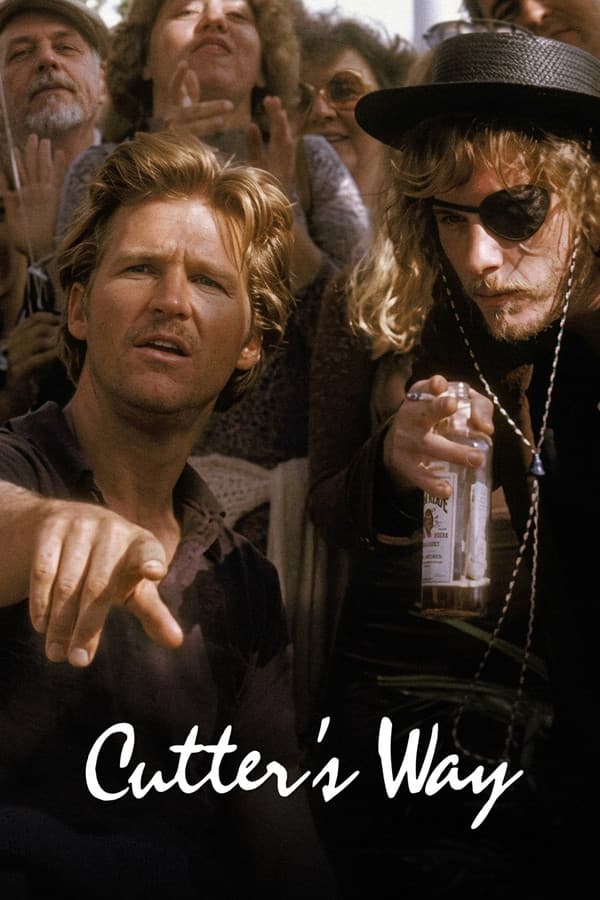
Cutter's Way
1981 • Crime, Drama, Mystery, Thriller • R
Alex Cutter is a boozy, belligerent and deeply cynical Vietnam veteran whose encounter with a landmine during the war has left him minus an eye, a leg and an arm. When his drifter playboy friend Richard Bone is falsely accused of murder, Cutter sets out for revenge in his own inimitable style.
Runtime: 1h 49m
Buy related books from Amazon
As an Amazon Associate I earn from qualifying purchases. Read the full disclosure.
Why you should read the novel
Before you watch Cutter's Way (1981), discover the razor-edged brilliance of Newton Thornburg’s novel Cutter and Bone. The book delivers intoxicating noir atmosphere, knife-sharp prose, and an intimate dive into Richard Bone and Alex Cutter’s tangled loyalties that the screen can only suggest.
Cutter and Bone rewards readers with layered psychology, moral ambiguity, and slow-burn suspense rooted in the post-Vietnam American malaise. Thornburg’s propulsive chapters, rich sense of place, and unflinching social critique build a deeper, more unsettling mystery than any two-hour runtime can capture.
If you love literary crime, California noir, and complex character studies, make the novel your first stop. Read Cutter and Bone by Newton Thornburg to experience the full emotional gravity, nuanced motivations, and chilling revelations that inspired the film Cutter’s Way.
Adaptation differences
Title and emphasis signal a key shift: the book is Cutter and Bone, underscoring the tense duality between Alex Cutter and Richard Bone, while the film is retitled Cutter’s Way, subtly pivoting focus toward Cutter’s worldview. The novel balances both men’s perspectives; the movie leans into mood and mythmaking around Cutter.
Character depth and interiority diverge. Newton Thornburg’s novel grants access to Bone’s doubts, Cutter’s trauma, and Mo’s simmering disillusionment through interior monologue and backstory. The adaptation necessarily compresses arcs, trimming secondary characters and subplots, and uses performance and visual shorthand where the book offers psychological detail.
Structure and ambiguity are handled differently. The novel unfolds with more investigative texture—tendrils of rumor, class privilege, and local power—while the film favors elliptical, neo-noir atmosphere. Cutter’s Way condenses leads, collapses timelines, and keeps the tycoon J. J. Cord’s guilt cloaked in suggestion; the book develops broader social context and a more granular sense of cause and effect.
Setting and climax carry distinct textures. Thornburg’s mid-1970s milieu bristles with post-Watergate cynicism and energy-crisis anxiety; the film’s early-’80s Santa Barbara vibe is sun-dazed and dreamlike. The adaptation stages a punchier, symbolic final confrontation and cuts to an abrupt, haunting resolution, whereas the novel’s endgame stretches longer, tracing consequences and moral fallout with greater clarity.
Cutter's Way inspired from
Cutter and Bone
by Newton Thornburg