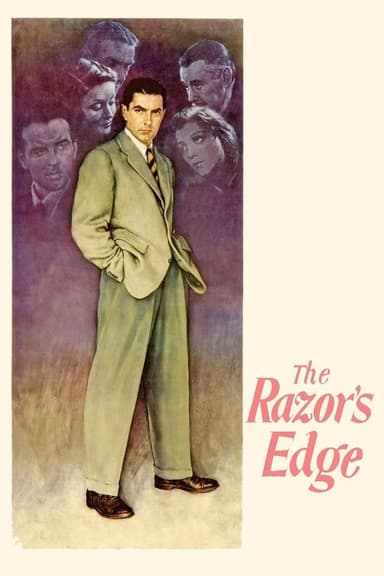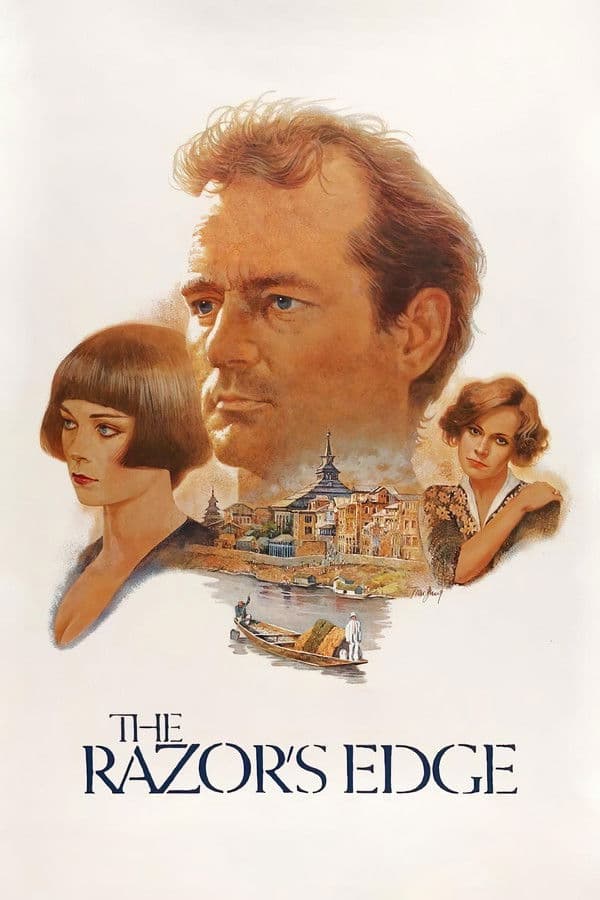
The Razor's Edge
1984 • Drama, Romance • PG-13
An American WWI veteran undertakes a spiritual quest that takes him from Paris to Nepal to the Himalayas and back to his hometown. Upon his return, he discovers he is not the only one who has changed.
Runtime: 2h 9m
Buy related books from Amazon
As an Amazon Associate I earn from qualifying purchases. Read the full disclosure.
Why you should read the novel
Discover the profound depth of W. Somerset Maugham’s The Razor’s Edge, a timeless novel that explores purpose, love, and enlightenment after the trauma of war. The book’s luminous prose and philosophical insight offer a richer, more intimate journey than any screen adaptation can provide.
Maugham’s unique presence as narrator weaves through Paris salons, Chicago boardrooms, and Indian ashrams, revealing the inner lives of Larry Darrell, Isabel Bradley, Sophie, and Elliott Templeton with rare delicacy. Reading the novel delivers nuanced motivations, moral ambiguity, and spiritual inquiry that the camera can only hint at.
If you enjoyed the 1984 film, the original book elevates the experience with layered character studies, elegant wit, and searching metaphysical conversations. Choose the source: read The Razor’s Edge novel for classic literature, a moving spiritual quest, and unforgettable storytelling.
Adaptation differences
The biggest difference between the The Razor’s Edge book and the 1984 movie is narrative perspective. In the novel, Maugham appears as a character-narrator, shaping events with commentary, irony, and insight. The film largely removes this literary frame, delivering a more straightforward, linear hero’s journey for Larry Darrell and reducing the novel’s reflective, essayistic texture.
Character development is also streamlined on screen. Isabel’s complexity and moral ambiguity, Sophie’s harrowing descent, Elliott Templeton’s satirical portrait, and Gray Maturin’s financial ruin and recovery occupy far greater psychological space in the book. The movie centers more tightly on Larry, compressing timelines and backstories, while the novel dwells on motives, consequences, and the private compromises that define each life.
The novel’s spiritual and philosophical depth is richer and more explicit. Maugham details Larry’s readings, practices, and conversations about Eastern thought, contrasting material success with inner freedom. The 1984 adaptation visualizes the journey—ashrams, travel, landscapes—but trims the metaphysical discourse, and its early touches of Bill Murray’s wry humor shift tone compared with the book’s sustained, contemplative seriousness.
Finally, the endings and social critique feel different. The book closes with a reflective coda that weighs each character’s fate and satirizes high society with a cool, unsentimental eye. The film favors emotional closure and cinematic momentum, softening or simplifying some of the novel’s sharper social observations and the stark consequences surrounding secondary characters, yielding a cleaner arc for Larry than Maugham’s more ambivalent summation.
The Razor's Edge inspired from
The Razor's Edge
by W. Somerset Maugham