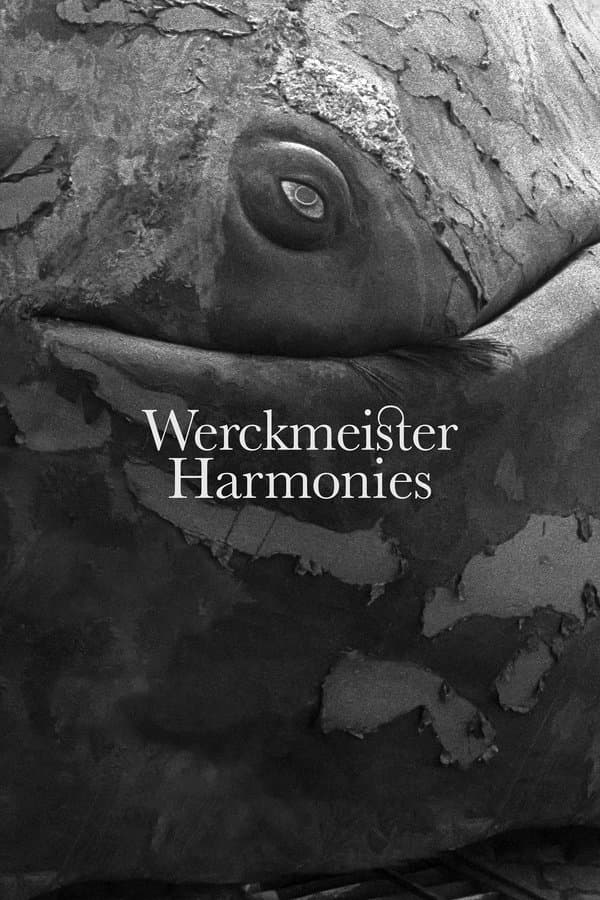
Werckmeister Harmonies
2001 • Drama
A naive young man witnesses an escalation of violence in his small hometown following the arrival of a mysterious circus attraction.
Runtime: 2h 19m
Buy related books from Amazon
As an Amazon Associate I earn from qualifying purchases. Read the full disclosure.
Why you should read the novel
Before you watch or rewatch Werckmeister Harmonies, experience its source: The Melancholy of Resistance by László Krasznahorkai. The novel reveals the full psychological depth, political nuance, and philosophical resonance that the film only hints at, making it essential reading for fans of Béla Tarr’s cinema and modern European literature.
Krasznahorkai’s book immerses you in the town’s collective unraveling through long, hypnotic sentences, interior monologues, and multiple viewpoints. You’ll meet the key players—János Valuska, Mr. Eszter, and Tünde Eszter—in richer detail, while encountering expansive reflections on order, chaos, music, and power that simply can’t fit on screen.
If the film’s images haunted you, the novel’s language will stay with you even longer. Read The Melancholy of Resistance to uncover backstories, motives, and societal dynamics that make the narrative more gripping, the allegory more precise, and the ultimate message more provocative and timely.
Adaptation differences
Book vs movie focus: Werckmeister Harmonies narrows its gaze primarily to János Valuska and a handful of emblematic events, while The Melancholy of Resistance unfolds through multiple perspectives and extensive interior monologues. The novel delves into characters’ private logic and fears, whereas the film’s sparse dialogue and long takes embrace ambiguity and silence.
Political storyline and world-building: In the book, Tünde Eszter’s authoritarian rise is detailed through committees, decrees, and careful social maneuvering. Krasznahorkai shows how bureaucracy, rumor, and opportunism enable her consolidation of power. The film compresses this into suggestive moments and off-screen developments, prioritizing mood and atmosphere over explicit policy shifts and institutional processes.
The circus, the Prince, and unrest: The novel treats the demagogic dwarf known as the Prince and the mechanics of crowd manipulation with greater clarity, charting wider, sustained unrest across the town. Tarr’s adaptation keeps the Prince mostly unseen or inaudible, uses the whale as a central visual metaphor, and condenses violence into a few devastating set pieces (notably the hospital sequence), favoring ominous rumor and suggestion over granular causality.
Structure, music, and ending: Tarr adds iconic cinematic elements—like the barroom “solar system” prologue—that aren’t presented the same way in the novel. The book devotes pages to Mr. Eszter’s polemic against equal temperament and to Werckmeister’s tuning theories; the film distills these into brief scenes and an evocative score. The novel offers a clearer aftermath of the upheaval and the political consolidation that follows, while the film ends more openly, with János’s fate and the town’s future left in contemplative suspension.
Werckmeister Harmonies inspired from
The Melancholy of Resistance
by László Krasznahorkai