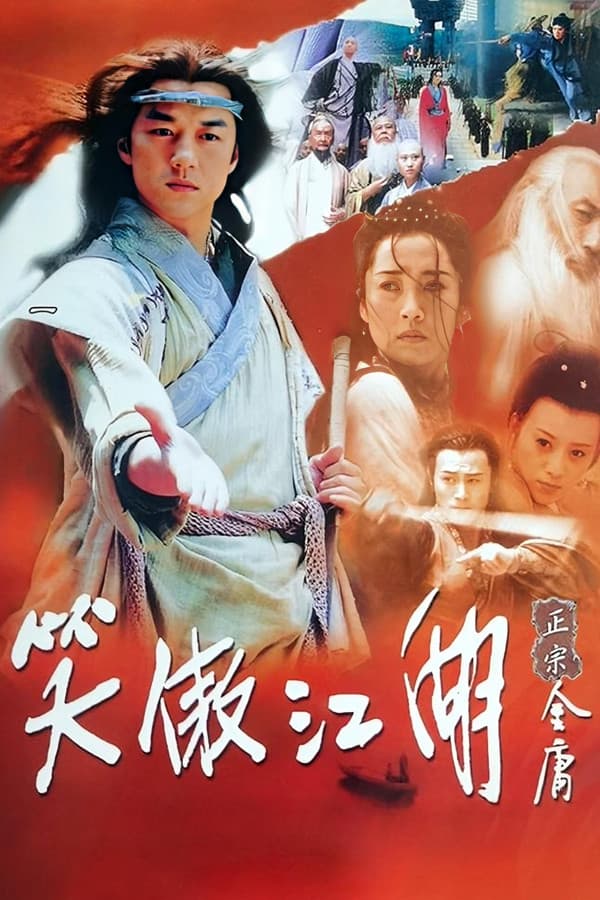
Laughing in the Wind
2001 • Action & Adventure, Drama
Laughing in the Wind is a 2001 Chinese television series produced by Zhang Jizhong, starring Li Yapeng and Xu Qing in the leading roles. The series is an adaptation of Louis Cha's novel The Smiling, Proud Wanderer. It was first broadcast on CCTV in China in 2001.
Buy related books from Amazon
As an Amazon Associate I earn from qualifying purchases. Read the full disclosure.
Why you should read the novel
Before you watch Laughing in the Wind (2001), experience the unfiltered power of Jin Yong’s The Smiling, Proud Wanderer. This wuxia classic delivers deeper character arcs, razor-sharp satire, and a richer moral landscape than any screen adaptation can capture.
The novel’s pages unlock the full psychology of Linghu Chong, Ren Yingying, and Yue Buqun, revealing motives and betrayals that feel earned and devastating. You’ll savor the intricate martial-arts lore—from the Sunflower Manual to the Bixie Sword Art—explained with nuance, philosophy, and wit.
Reading the book connects you to Jin Yong’s lyrical prose, elegant swordplay metaphors, and timeless reflections on freedom versus conformity. If you love epic worldbuilding, layered politics, and unforgettable duels, The Smiling, Proud Wanderer is the definitive, must-read source material.
Adaptation differences
Structure and pacing: The 2001 TV series streamlines the novel’s sprawling journey, condensing timelines, merging minor roles, and reordering some episodes for clarity and momentum. Internal monologues and philosophical asides—vital to the book’s tone—are trimmed to prioritize plot and action beats.
Character focus: Linghu Chong’s irreverent, free-spirited voice in the novel is often tempered into a more straightforward heroic lead on screen. Yue Buqun’s hypocrisy is foreshadowed earlier and portrayed more overtly, while Yue Lingshan’s conflicted loyalties are simplified to keep the love-triangle dynamics clear and brisk.
Antagonists and sect politics: The series typically gives Zuo Lengshan and the Five Mountains merger a cleaner, singular-villain emphasis. Dongfang Bubai’s portrayal is less transgressive than in the novel, with the relationship and gender ambiguity around Yang Lianting softened in favor of action-driven showdowns. The Sun Moon Holy Cult is framed more sympathetically, earlier, to streamline alliances and stakes.
Themes and ending texture: Broadcast-friendly storytelling reduces graphic violence and some of the novel’s sharper social satire. The friendship and musical ideal of Qu Yang and Liu Zhengfeng—central to the book’s ethos—is abbreviated, and the finale provides firmer on-screen closure. By contrast, the novel leans into ambiguity, leaving Linghu Chong and Ren Yingying choosing personal freedom over sect power and political entanglements.
Laughing in the Wind inspired from
The Smiling, Proud Wanderer (also translated as State of Divinity; Xiao Ao Jiang Hu)
by Jin Yong (Louis Cha)