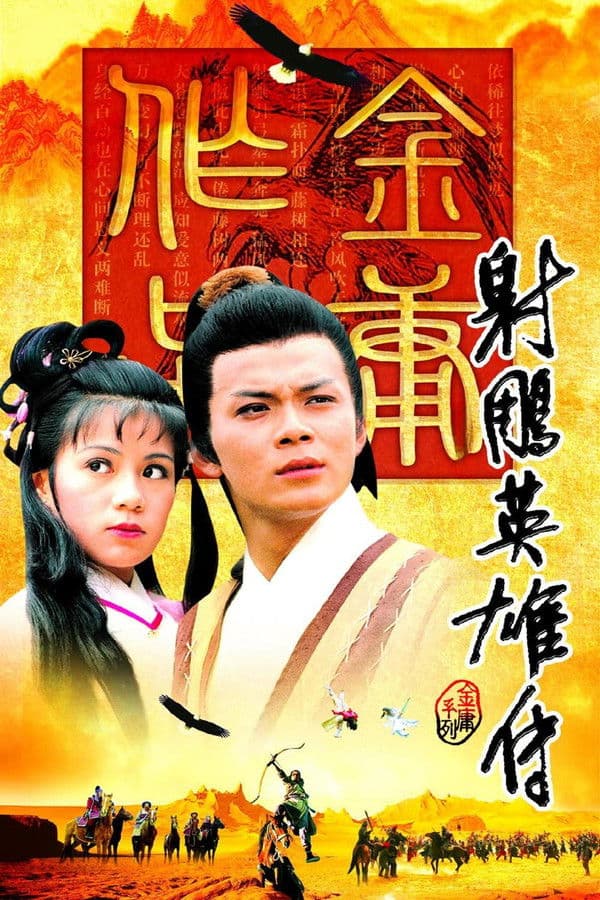
The Legend of the Condor Heroes
1983 • Action & Adventure, Drama
The Legend of the Condor Heroes is a Hong Kong television series adapted from Louis Cha's novel of the same title. It was first broadcast on TVB Jade in Hong Kong in 1983. The 59 episodes long series is divided into three parts. This 1983 version is considered by many to be a classic television adaptation of the novel and features the breakthrough role of Barbara Yung, who played Huang Rong.
Buy related books from Amazon
As an Amazon Associate I earn from qualifying purchases. Read the full disclosure.
Why you should read the novels
Experience Jin Yong’s sweeping martial arts epic as it was meant to be read. The Legend of the Condor Heroes books deliver layered world-building, intricate sect rivalries, and character motivations that television can only hint at. In English translation, these volumes capture the poetry, philosophy, and moral dilemmas that define wuxia at its best.
Readers who loved the 1983 TV series will find richer backstories for Guo Jing, Huang Rong, Yang Kang, and the great masters, along with deeper explorations of loyalty, identity, and honor amid Song–Jin tensions. The novels unfold at a deliberate pace, rewarding you with revelations, cultural detail, and tactical ingenuity that elevate every duel and decision.
The English editions are crafted for modern readers while preserving Jin Yong’s voice—making them ideal for newcomers and longtime fans. If you want the full tapestry of techniques, manuals, and rivalries—from beggars’ staff arts to arcane inner energy—choose the books and immerse yourself in the definitive Condor Heroes experience.
Adaptation differences
Scope and pacing are the most noticeable differences between the 1983 adaptation and the novel. The series compresses timelines, merges events, and streamlines travel and training arcs to fit episodic television. This keeps momentum high on screen, but the books provide fuller journeys, extended mentorships, and gradual power growth that clarify how and why characters advance in martial arts.
Characterization also shifts. On TV, iconic figures such as Huang Rong and Yang Kang receive emphasis shaped by performance, screen chemistry, and broadcast tone—often making them more immediately charming or sympathetic. In the novels, motives, inner conflicts, and moral turns are explored at greater length, with additional context from family histories, sect traditions, and personal codes that sharpen each character’s choices.
Plot details and lore are simplified for clarity on screen. The series condenses sect politics, reduces the complexity of manuals and techniques, and reorders or trims certain encounters. Some secondary characters are combined or sidelined, and a few confrontations or reveals occur earlier or later than in the books. As a result, cause-and-effect is cleaner in the show, while the novels reward readers with denser intrigue and more nuanced rivalries.
Tone and historical texture differ as well. The TV version balances heroism with light comedy and broadcast-friendly romance, while the books lean further into philosophical themes, shifting allegiances, and the weight of Song–Jin geopolitics. Violence and tragedy are often softened or reframed on screen, whereas the novels allow darker consequences and ethical ambiguity to resonate, giving the saga a broader emotional and thematic range.
The Legend of the Condor Heroes inspired from
A Snake Lies Waiting (The Legend of the Condor Heroes, Book 3)
by Jin Yong (Louis Cha)
A Heart Divided (The Legend of the Condor Heroes, Book 4)
by Jin Yong (Louis Cha)
A Bond Undone (The Legend of the Condor Heroes, Book 2)
by Jin Yong (Louis Cha)
A Hero Born (The Legend of the Condor Heroes, Book 1)
by Jin Yong (Louis Cha)