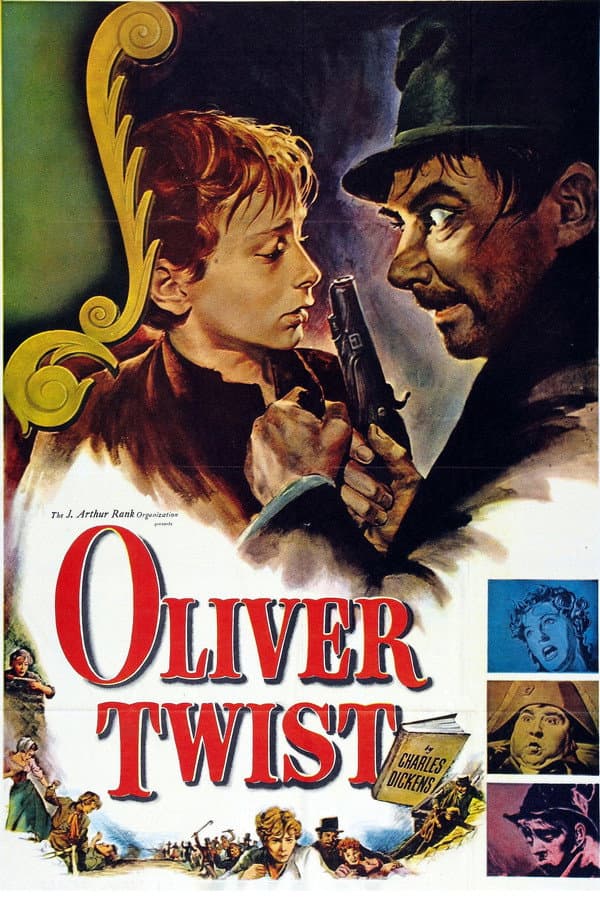
Oliver Twist
1948 • Adventure, Comedy, Crime, Drama • NR
When 9-year-old orphan Oliver Twist dares to ask his cruel taskmaster, Mr. Bumble, for a second serving of gruel, he's hired out as an apprentice. Escaping that dismal fate, young Oliver falls in with the street urchin known as the Artful Dodger and his criminal mentor, Fagin. When kindly Mr. Brownlow takes Oliver in, Fagin's evil henchman Bill Sikes plots to kidnap the boy.
Runtime: 2h 1m
Buy related books from Amazon
As an Amazon Associate I earn from qualifying purchases. Read the full disclosure.
Why you should read the novel
Before you watch or rewatch the 1948 film Oliver Twist, read the original novel Oliver Twist by Charles Dickens. The book delivers Dickens’s unabridged social satire, razor‑sharp humor, and aching compassion for the poor, told in a narrative voice no screen can replicate.
The novel contains entire threads the film compresses or omits, including the Monks inheritance conspiracy, Rose Maylie and the Maylie household, and the full comeuppance of Mr. Bumble under the harsh Poor Law he enforces. These arcs deepen the stakes, reveal Oliver’s true identity, and expand the world beyond the criminal underclass.
Because Dickens’s text is public domain, you can read it unabridged in affordable annotated editions or free digital copies. Choose the full novel to savor Dickens’s language, layered themes, and vivid London—details a two‑hour adaptation simply can’t capture.
Adaptation differences
Plot scope and structure differ markedly between the book and the 1948 film. David Lean’s adaptation condenses the serialized narrative, largely omitting the Monks inheritance plot and removing most of the Maylie household arc, which in the novel provides Oliver’s convalescence and moral sanctuary. As a result, Oliver’s parentage and legal inheritance are simplified or sidelined, and Mr. Brownlow’s role becomes a more streamlined anchor for the story.
Characterization also shifts. The film’s Fagin is presented as a darker, more overtly menacing figure (with controversial makeup), whereas Dickens mixes menace with grim humor and authorial irony. Nancy’s inner conflict and backstory are compressed for pacing, the Artful Dodger’s wit and social commentary are reduced, and Mr. Bumble’s hypocritical pomposity—central to Dickens’s Poor Law satire—receives far less narrative space.
Tone and themes change with the medium. The novel balances social critique, humor, and pathos through an omniscient narrator, digressions, and sharp asides; the film favors visual expressionism, suspense, and momentum. Consequently, cinematic urgency and noir‑ish atmosphere eclipse much of the book’s institutional satire and moral argument about charity, bureaucracy, and systemic cruelty.
The endings diverge in emphasis. Dickens resolves every thread: Fagin faces execution in a harrowing final chapter, Monks confesses and loses his claim, the Bumbles are disgraced, and Oliver’s lineage and inheritance are fully secured with the help of Brownlow and the Maylies. The 1948 film concludes shortly after Sikes’s death and Fagin’s capture, offering a tidier, faster resolution that forgoes the novel’s extended revelations and legal untangling.
Oliver Twist inspired from
Oliver Twist; or, The Parish Boy's Progress
by Charles Dickens