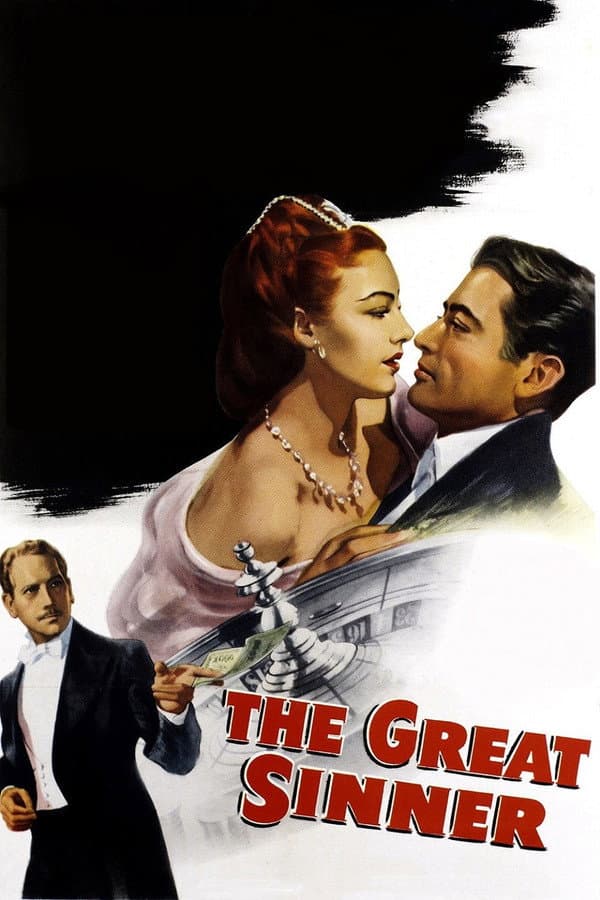
The Great Sinner
1949 • Drama, Romance • NR
A young man succumbs to gambling fever.
Runtime: 1h 50m
Buy related books from Amazon
As an Amazon Associate I earn from qualifying purchases. Read the full disclosure.
Why you should read the novel
Skip the screen and experience Dostoevsky’s The Gambler in all its raw psychological immediacy. The novel places you inside the feverish mind of a man consumed by roulette, risk, and forbidden love.
Reading the book reveals the razor-sharp social satire, volatile inner monologue, and whip‑fast shifts between bravado and despair that a movie can only hint at. You’ll meet vivid characters, navigate high‑stakes rooms in a European spa town, and feel each spin’s exhilaration and dread.
If you want the full depth of obsession, power, and self‑deception—along with Dostoevsky’s timeless insights—choose the source. The Gambler book offers gripping pacing, unforgettable voice, and a richer payoff than any adaptation.
Adaptation differences
The Great Sinner is loosely adapted from The Gambler, and the film reshapes Dostoevsky’s lean, urgent tale into a glossy Hollywood melodrama. The adaptation amplifies the grand romance and moral caution while softening the novel’s jagged edges and existential bite to fit studio-era expectations and Production Code sensibilities.
Point of view shifts dramatically. Dostoevsky’s novel is a breathless first‑person confession from a tutor whose voice swings between defiance and collapse. The movie recasts the protagonist as a more conventionally heroic outsider—often a writer figure—externalizing inner turmoil through dialogue and plot rather than the book’s claustrophobic, unreliable narration.
Characters and incidents are streamlined. Where the novel’s ensemble (the General, Polina, Mr. Astley, de Grieux, and the formidable Grandmother) collides in a tight spiral of debts and manipulations, the film omits, compresses, or combines roles to emphasize a central love story and a single dominant antagonist. Settings shift from Dostoevsky’s fictional Roulettenburg to a glamorized European resort, with timelines tightened and high‑stakes episodes rearranged for dramatic momentum.
Themes and outcomes tilt toward redemption. The Gambler leaves its narrator exposed—brilliant, self‑aware, and still trapped by compulsion—while the film frames gambling as a cautionary spectacle that virtue or love can ultimately overcome. The result trades the novel’s jagged psychological realism and moral ambiguity for polished spectacle and a clearer moral message—engaging on screen, but far less harrowing than Dostoevsky’s original.
The Great Sinner inspired from
The Gambler
by Fyodor Dostoevsky